Guides · Private equity and private markets
How much private equity pension funds hold, and how they value it.
Facts checked
The pension funds in the chart below put between 2% and 22% of their assets in private equity. In the UK, the Local Government Pension Scheme in England and Wales held 6% at 31 March 2025; CPP Investments, which runs the Canada Pension Plan, held 22% at 31 March 2026. Most UK workplace defaults hold less: 2% or under in master trust defaults, and 5% in Nest's 2046 fund. Seventeen providers and schemes have said they aim to put at least 10% of their main defaults into private markets by 2030. This page sets out those shares, so you can compare your own mix with them, and how pension funds value holdings that have no market price. It describes what funds hold; it is not a recommendation.
How much private equity pension funds hold
Private equity as a share of a pension fund's assets: UK funds 2% to about 7%, US public pensions 13.6% to 18.5%, Canadian funds 14.3% to 22%, Australian APRA-regulated super 4.3% to 5.7% in unlisted equity (latest published figures)
Four small bar charts on one scale, one per country, each showing private equity as a share of assets. UK: private-sector defined benefit schemes about 6.7% (Purple Book 2025, worked out), Local Government Pension Scheme in England and Wales 6% (31 March 2025), Nest 2046 default fund 5% (report for the year to 31 March 2026), master trust defaults 30 years from retirement 2% (31 December 2025). US: state and local pensions 13.9% (fiscal 2025), CalPERS 18.5% after borrowing (31 December 2025), CalSTRS 13.6% (30 June 2026). Canada: CPP Investments 22% (31 March 2026), Ontario Teachers' 19% (31 December 2025), all trusteed pension funds 14.3% (first quarter 2026). Australia: APRA-regulated super funds 4.3% (30 June 2026), MySuper defaults 5.7% (30 June 2026).
UK
i
The defined benefit bar covers private-sector schemes. Fairworth worked it out by multiplying the equity share by the unquoted share of equities, which may count more than private equity funds; the Purple Book draws on scheme accounts from 2023 on.
Source: Pension Protection Fund, Purple Book 2025; LGPS Scheme Advisory Board, Scheme Annual Report 2025; Nest; The Pensions Regulator, Master trust asset allocation 2026.
US
i
CalPERS's share, of its fund after borrowing, is worked out by Fairworth from its figures.
Source: Public Plans Data; CalPERS Trust Level Review; CalSTRS.
Canada
i
The trusteed funds bar is a share of gross assets, worked out by Fairworth from Statistics Canada's figures.
Source: CPP Investments; Ontario Teachers' Pension Plan; Statistics Canada table 11-10-0084-01.
Australia
i
Both bars are unlisted equity, which APRA does not split into private equity and venture capital, and exclude self-managed funds.
Source: APRA, Quarterly superannuation industry publication June 2026, tables 9 and 9a.
Show the figures as a table
| Country | Pension fund | Private equity | As of |
|---|---|---|---|
| UK | Defined benefit: private sector | 6.7% | Purple Book 2025 |
| UK | LGPS: England and Wales | 6.0% | 31 Mar 2025 |
| UK | Nest: 2046 default | 5.0% | 2025/26 report |
| UK | Master trusts: 30 years out | 2.0% | 31 Dec 2025 |
| US | State and local: all plans | 13.9% | FY2025 |
| US | CalPERS: PERF | 18.5% | 31 Dec 2025 |
| US | CalSTRS: portfolio | 13.6% | 30 Jun 2026 |
| Canada | CPP Investments: net assets | 22.0% | 31 Mar 2026 |
| Canada | Ontario Teachers': net investments | 19.0% | 31 Dec 2025 |
| Canada | Trusteed funds: gross assets | 14.3% | Q1 2026 |
| Australia | APRA funds: unlisted equity | 4.3% | 30 Jun 2026 |
| Australia | MySuper: unlisted equity | 5.7% | 30 Jun 2026 |
US state and local pensions held 13.9% in private equity in fiscal 2025, as the plans report it. CalPERS held $110.8bn of its $600.2bn fund after borrowing, 18.5%, at 31 December 2025. In Canada, private equities were 14.3% of trusteed pension funds' gross assets in the first quarter of 2026: 15.1% for public sector funds and 10.2% for private sector ones. In Australia, unlisted equity was 4.3% of APRA-regulated super funds' investments at 30 June 2026 and 5.7% in MySuper defaults; APRA does not split it into private equity and venture capital.
No published source gives a private equity share for UK workplace defined contribution pensions as a whole, or for US 401(k) plans. US rules on private equity inside 401(k) funds are still changing: a final rule from the Department of Labor was sent for White House review on 5 November 2026 and had not been published when this page was checked.
Private markets are coming to UK workplace defaults
Under the Mansion House Accord of 13 May 2025, 17 workplace pension providers and schemes, among them Nest, Aviva, Legal & General and The People's Pension, set an ambition of at least 10% of their main defined contribution default funds in private markets by 2030, with at least 5% of the total in the UK. The pledge is voluntary and depends on the providers' duties to their members and on enough suitable assets being available. "Private markets" here means more than private equity: unlisted shares, property, infrastructure and private debt. At the end of 2025 the signatories held 6.6% of their default funds' growth-phase assets in private markets, according to the first progress update; of the £11.1bn in the UK, £0.5bn was private equity and £8bn property.
The Pension Schemes Act 2026 also lets the government require a share of main default funds in private assets, including private equity and venture capital, of no more than 10%, and no more than 5% in the UK. The power cannot be used before 1 January 2028, can be used once, and ends at the end of 2035; it has not been used. If defaults reach these levels, more of their value would come from valuations rather than market prices.
How a holding with no market price is valued
A private equity fund's value is the manager's estimate, reported on a statement, and it can be months old by the time a pension fund reports it. CalSTRS's private equity return for the year to 30 June 2026 used valuations as of 31 March 2026. In Australia, APRA reviewed how 23 super trustees, holding about 80% of the assets it regulates, valued unlisted assets, and in December 2024 found that 12 needed material improvement in valuation governance, liquidity risk management or both; the weaknesses included board oversight, how often and when assets were revalued, and valuation controls. In September 2026 it proposed that trustees value their investments at least quarterly and get an external valuation where APRA directs; the proposal is under consultation until 3 February 2027.
How Fairworth shows it
In Fairworth, you record a private equity fund's commitment, each capital call, each distribution and each NAV from a statement. The free plan includes one fund, and the paid plan any number. The fund's page shows what you have called, what has been distributed, the NAV, DPI, TVPI and IRR. Between statements the NAV is the last reported one plus calls, less distributions since, and the NAV, DPI, TVPI and IRR tooltips give the last statement's date. The same page compares the fund's cash flows with an index you choose, using the KS-PME and direct alpha measures. Your private funds are counted in your net worth beside your listed investments, property and cash.
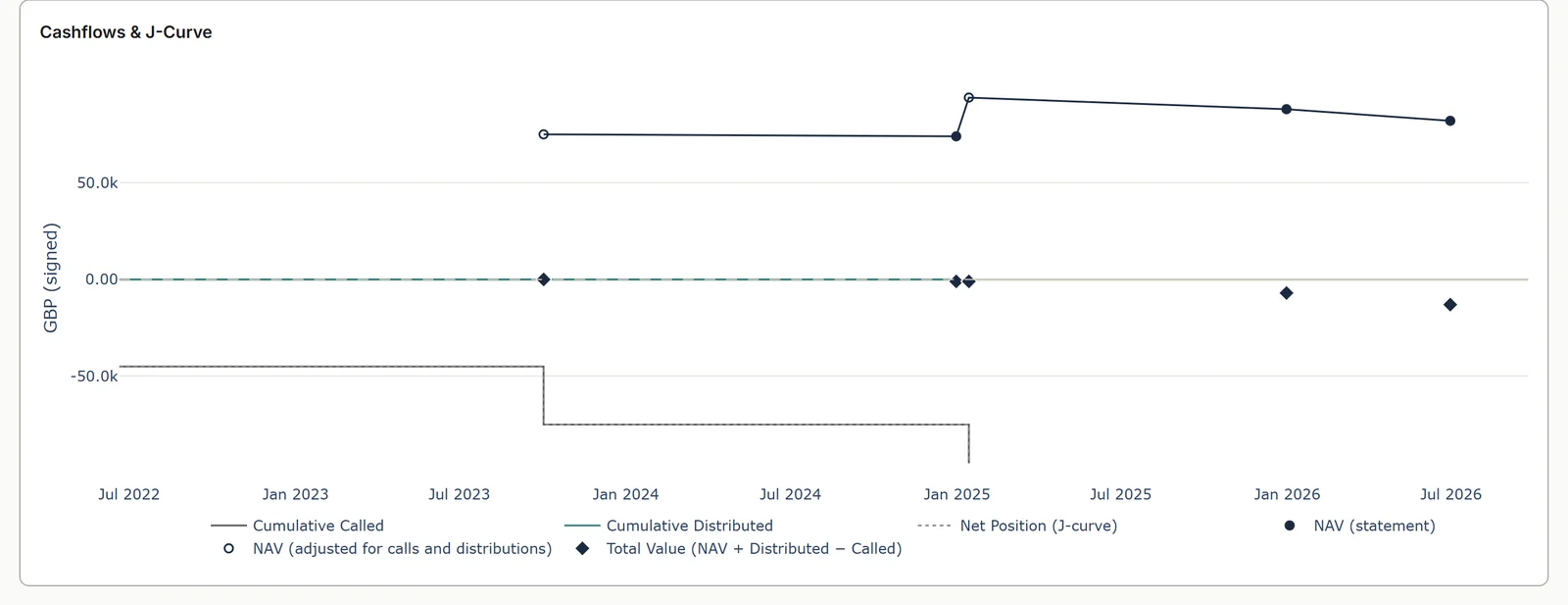
Swipe the screenshot sideways to read it
On the paid plan, the AI document reader turns capital call notices, distribution notices and capital account statements into entries for you to approve. Private assets held inside a listed fund, such as a workplace default, are not shown separately: Fairworth's look-through splits a fund by region, sector and currency only.
The free private equity fund returns tool shows TVPI and DPI by vintage year and strategy, as published by the public pension funds that invest in the funds.
What this means for your own mix
- Private equity. The pension funds in the chart held between 2% and 22% of their assets in private equity, in their latest published figures; in the UK, from none in the median master trust default to about 7% in private-sector defined benefit schemes.
- Your workplace pension. If your workplace pension is with an Accord signatory, the provider or scheme has said it aims for at least 10% in private markets across its main defaults by 2030; of the UK private markets money counted so far, £0.5bn of £11.1bn was private equity.
- Valuations. A private holding's value is an estimate with a date; the date matters as much as the figure. For how the value moves over a fund's life, see the private equity J-curve.
More on Private equity and private markets
- What a Moonfare fund really costs: three worked examples ExplainerThree Moonfare feeders' fees from their own documents, the gross return each needs for a given net return to you, and where the profit goes.
- Moonfare capital calls: notices, timing and the cash they need Explainer27 capital call notices from seven Moonfare feeders: notice periods, first calls, how fast commitments were called and what a missed call costs.
- Your return from a Moonfare fund vs the platform's figure ExplainerOne Moonfare fund's gross, net and own-cash-flow returns at the same date, what each label means, and when your IRR differs from the feeder's.
Further reading
- Pension schemes back British growth (HM Treasury): the Mansion House Accord.
- Master trust asset allocation 2026 (The Pensions Regulator): private markets in master trust defaults.
- How to track a private equity fund: calls, distributions, NAV and returns.
- What pension default funds hold: shares, bonds and cash in each country's defaults.
Figures are the latest each source published, checked on 14 November 2026, each with its own date. The UK defined benefit share, CalPERS's share and the Canadian trusteed shares are worked out from the sources' own figures. This page compares pension funds; it does not rank them. It is information, not financial or investment advice.