All four countries pay retirement income from three pillars: a state pension, pensions arranged through employers, and personal saving. They differ in how much each pillar carries, whether saving is compulsory, and whether a pension is paid from capital set aside in advance or from each year's taxes. Measured against the size of the economy, the capital set aside is large: about 1.6 times a year's GDP in the US, Canada and Australia, and about 1.1 times in the UK, whose total has to be added up from several official sources because no single one exists. This page sets out how each system is built, how big it is, who runs the money, and the vocabulary the rest of the series uses.
How pensions work in each country: three pillars
Each country has the same three pillars: a state pension paid by the government, workplace pensions arranged through employers, and personal saving people arrange themselves. Australia's Treasury review names them the "three pillars", and the same frame fits the other three countries. Two questions separate them:
- Funded or unfunded? A funded pension is paid from a pool of capital built up in advance and invested. An unfunded pension, also called pay-as-you-go, is paid from the taxes or contributions collected each year, with no invested pool behind it.
- Compulsory, automatic or voluntary? Whether workers must save, are enrolled automatically with the right to opt out, or choose for themselves.
UK
- Pillar 1, the State Pension: unfunded. It is paid from National Insurance contributions on a pay-as-you-go basis. The Great Britain National Insurance Fund held £89.2bn at 31 March 2026: a working balance, above its minimum of one sixth of a year's benefit spending (£25.4bn), not an invested reserve.
- Pillar 2, workplace pensions: automatic; funded, except most public service schemes. Auto-enrolment began in 2012: employers enrol eligible workers, who may opt out. The minimum total contribution is 8%, of which the employer pays at least 3%, on earnings between £6,240 and £50,270 a year in most schemes (2026/27). Private-sector schemes and the Local Government Pension Scheme are funded. Most other public service schemes are unfunded: they pay pensions as they go, the Treasury pays what contributions do not cover each year, and their promises were valued at £1.4 trillion at the end of 2024-25.
- Pillar 3, personal pensions: voluntary and funded. Personal pensions and SIPPs, where the holder chooses the investments. SIPPs held about £567bn in 2024.
US
- Pillar 1, Social Security: mostly unfunded, with a reserve. Payroll tax brought in 91.3% of its revenue in 2025, and that income goes mostly on paying the same year's pensions. Its trust funds held a reserve of US$2,561.3bn at the end of 2025 (about £1.9tn), about 8.1% of GDP, invested by law in special US Treasury obligations. In 2025 its costs exceeded its whole income, so the reserve fell; the trustees project it will run out in 2034.
- Pillar 2, workplace pensions: voluntary, and funded. Nothing obliges employers or workers to contribute, though new 401(k) and 403(b) plans, with some exceptions, must enrol workers automatically for plan years beginning after 2024, unless the worker elects not to contribute or to contribute at a different rate. Employer plans hold invested funds, but state and local government DB plans held US$2,354bn less than their promises at 30 June 2026 (about £1.8tn).
- Pillar 3, IRAs: voluntary and funded. Individual retirement accounts, often filled by rolling money over from a 401(k), held US$19,850bn at 30 June 2026 (about £15.0tn).
Canada
- Pillar 1, two state pensions: one unfunded, one partly funded. Old Age Security is paid from general tax revenue from age 65: unfunded. The earnings-related Canada Pension Plan is partly funded: it is paid for by contributions and also holds an invested fund. CPP Investments held C$793.3bn at 31 March 2026 (about £430bn), about 23.8% of GDP. Quebec runs its own plan, whose fund held C$163.5bn at the end of 2025 (about £89bn).
- Pillar 2, workplace pensions: voluntary; funded, except some government plans. Employers need not offer a plan, except that Quebec employers above a minimum size that offer no other eligible plan must offer a savings plan with automatic enrolment. Most plans are invested funds, but some government plans are unfunded promises paid from government revenue: C$297.7bn of them at the end of 2022 (about £183bn).
- Pillar 3, RRSPs: voluntary and funded. Personal registered plans held C$1,531.8bn at the end of 2022 (about £940bn). Tax-free savings accounts (TFSAs) can be used for any purpose, not only retirement, so this page keeps them apart.
Australia
- Pillar 1, the Age Pension: unfunded. It is means-tested and "paid out of consolidated Government revenue". The government's Future Fund is not superannuation and is left out of the figures below.
- Pillar 2, superannuation: compulsory and funded. Employers must pay at least 12% of a worker's earnings into a super fund, where it is invested.
- Pillar 3, voluntary saving: funded. Members can add their own money to the same super funds, or run a self-managed super fund (SMSF).
How big each system is
The figures below are the capital currently set aside and invested to pay pensions: the funded part of pillars 2 and 3, plus Canada's CPP and QPP funds. Unfunded promises, such as the UK State Pension and most UK public service schemes, have no capital behind them and are not in these totals, with one exception: Canada's official total also counts C$297.7bn of unfunded government plans at the end of 2022, about 10 points of its 156.2% of GDP. The table gives each country's latest official figure in its own currency and in pounds at the Bank of England rate on the figure's own date, as a share of GDP, and per person; pound amounts are rounded.
| Country | Capital set aside | % of GDP | Population | Per person | As of |
|---|---|---|---|---|---|
| UK | £3,273.9bn | 107.5% | 69.5m | £47,100 | Mar 2025 to Mar 2026 |
| US | US$51,207bn (£38.6tn) | 157.3% | 341.8m | US$149,800 (£112,900) | 30 Jun 2026 |
| Canada | C$4,473.3bn (£2.7tn) | 156.2% | 39.5m | C$113,300 (£69,600) | 31 Dec 2022 |
| Australia | A$4,767.2bn (£2.5tn) | 162.7% | 27.9m | A$170,700 (£89,100) | 30 Jun 2026 |
Each country counts in its own way; the chart notes below say how.
Capital set aside for pensions is worth about 1.1 times a year's GDP in the UK, and about 1.6 times in the US, Canada and Australia
Show the figures as a table
| Country | % of GDP | As of |
|---|---|---|
| UK | 107.5% | Mar 2025 to Mar 2026 |
| US | 157.3% | 30 Jun 2026 |
| Canada | 156.2% | 31 Dec 2022 |
| Australia | 162.7% | 30 Jun 2026 |
Pension capital per person, in pounds: about £47,100 in the UK, £112,900 in the US, £69,600 in Canada (2022) and £89,100 in Australia
Show the figures as a table
| Country | £ per person | As of |
|---|---|---|
| UK | £47,100 | Mar 2025 to Mar 2026; population mid-2025 |
| US | £112,900 | 30 Jun 2026; population 1 Jul 2025 |
| Canada | £69,600 | 31 Dec 2022; population 1 Jan 2023 |
| Australia | £89,100 | 30 Jun 2026; population 31 Mar 2026 |
Canada's total is almost four years old: Statistics Canada stopped updating it after 2022. Two of its parts have newer figures, each with its own date: registered pension plans with active members held C$2,540.9bn at plan year-ends in 2024 (about £1.4tn), and CPP Investments C$793.3bn at 31 March 2026 (about £430bn). TFSAs, which the official total does not name and this page keeps apart, held C$745.2bn at the end of 2024 (about £410bn).
Why the UK has no single total
No UK statistic covers every kind of pension. The figures come from different bodies, at different dates, and some overlap. This page adds up four official sources:
- private-sector defined benefit schemes, £1,068.1bn at 31 March 2025 (Pension Protection Fund);
- the Local Government Pension Scheme across the UK, £480.3bn at 31 March 2025 (national statistics for England and Wales, Scotland and Northern Ireland);
- trust-based defined contribution schemes, £249.1bn in 2025 (The Pensions Regulator);
- contract-based pensions reported to the FCA, including personal and group personal pensions, SIPPs and drawdown, £1,476.4bn in the year to 31 March 2026.
That comes to £3,273.9bn. Besides the unfunded pensions described above, it leaves out annuities already being paid by insurers. The Office for Budget Responsibility puts the Local Government Pension Scheme at about £550bn rather than £480.3bn; this page uses the national statistics.
The ONS's survey of funded occupational schemes gives a higher figure. Used in place of the first three sources, it makes the total £3,618.4bn at 31 March 2026, or 117.7% of GDP in the year to March 2026, about £345bn more. Most of the gap is in defined contribution and public-sector schemes, and much of it is timing: the ONS figure is for March 2026, while the regulator's and local government figures are for 2025. At 31 March 2025 the ONS put these schemes at £871bn, against £729bn from the other sources. The ONS also counts hybrid and very small schemes that the regulator leaves out; the rest is unexplained.
International tables such as the OECD's show the UK at about 74% of GDP. That OECD figure covers occupational schemes only and leaves out contract-based pensions such as SIPPs and group personal pensions, so it understates the UK beside the other three countries, and this series does not use it as the UK total.
Where does pension capital sit, and who invests it?
Pension capital sits in a few kinds of pool in each country, but the number of pools behind each kind runs from one fund to hundreds of thousands
Four small bar charts, one per country, of pension capital by kind of pool, in billions of local currency, each with how many pools there are. UK (£bn): workplace DB, private sector 1,068 (4,840 schemes); workplace DB, local government in England and Wales 402 (86 administering authorities, six pools); workplace DC, trust-based 249 (790 DC and hybrid schemes); workplace and personal DC, contract-based 1,476 (insurers and platforms), of which SIPPs about 567 in 2024 (5.3 million holders, 98 firms). US (US$bn): workplace DB, private sector 3,213 (46,233 plans); workplace DB, state and local government 7,132 (over 5,000 systems); workplace DB, federal and railroad 3,273 (Treasury-held funds); workplace DC 15,016 (790,610 private plans); personal pensions, IRAs 19,850 (individual accounts). Canada (C$bn): workplace DB and DC 2,541 (15,762 plans); personal pensions, RRSPs, RRIFs and similar 1,532 (individual accounts); public pension funds, CPP 793 and QPP 163 (one fund each). Australia (A$bn): APRA-regulated funds, industry 1,815 (19 funds), retail 933 (48 funds), public sector 654 (10 funds); exempt public schemes, mostly DB, 188 (17 schemes); self-managed super funds 1,107 (680,301 funds).
UK
US
Canada
Australia
Show the figures as a table
| Country | Kind of pool | Capital | How many | As of |
|---|---|---|---|---|
| UK | Workplace DB: private sector | £bn 1,068 | 4,840 schemes | 31 Mar 2025 |
| UK | Workplace DB: local government (E&W) | £bn 402 | 86 authorities, 6 pools | 31 Mar 2025; count May 2025 |
| UK | Workplace DC: trust-based | £bn 249 | 790 DC and hybrid schemes | 2025 |
| UK | Workplace and personal DC: contract-based | £bn 1,476 | insurers and platforms | year to 31 Mar 2026 |
| UK | Personal pensions: SIPPs, within the bar above | £bn 567 | 5.3m holders, 98 firms | 2024 |
| US | Workplace DB: private sector | US$bn 3,213 | 46,233 plans | 30 Jun 2026; plans 2023 |
| US | Workplace DB: state and local government | US$bn 7,132 | over 5,000 systems | 30 Jun 2026; systems undated |
| US | Workplace DB: federal and railroad | US$bn 3,273 | Treasury-held funds | 30 Jun 2026 |
| US | Workplace DC: 401(k), 403(b), 457, TSP | US$bn 15,016 | 790,610 private plans | 30 Jun 2026; plans 2023 |
| US | Personal pensions: IRAs | US$bn 19,850 | individual accounts | 30 Jun 2026 |
| Canada | Workplace DB and DC: registered pension plans | C$bn 2,541 | 15,762 plans | plan year-ends 2024 |
| Canada | Personal pensions: RRSPs, RRIFs and similar | C$bn 1,532 | individual accounts | end-2022 |
| Canada | Public pension fund: CPP | C$bn 793 | 1 fund | 31 Mar 2026 |
| Canada | Public pension fund: QPP | C$bn 163 | 1 fund | 31 Dec 2025 |
| Australia | APRA-regulated funds: industry | A$bn 1,815 | 19 funds | 30 Jun 2026 |
| Australia | APRA-regulated funds: retail | A$bn 933 | 48 funds | 30 Jun 2026 |
| Australia | APRA-regulated funds: public sector | A$bn 654 | 10 funds | 30 Jun 2026 |
| Australia | Exempt public schemes: mostly DB | A$bn 188 | 17 schemes | 30 Jun 2026 |
| Australia | Self-managed super: SMSFs | A$bn 1,107 | 680,301 funds | 30 Jun 2026 |
Capital is in billions of each country's own currency, on its own scale. The number of pools uses one log scale for all four. Dates differ; the table gives each one.
UK. Workplace pensions come in two kinds. Defined benefit (DB) schemes promise an income set by salary and service; defined contribution (DC) schemes build a pot. The 4,840 private-sector DB schemes are run by trustees, and the Pension Protection Fund protects their members. In the public sector, local government DB is backed by invested money, but most other public service schemes, such as the NHS and teachers' schemes, are pay-as-you-go: pensions are paid from current contributions, with the Treasury meeting the balance, so they have no pool to show. The chart shows England and Wales, whose 86 local government funds were given until March 2026 to pool their investments into six; Scotland and Northern Ireland add about £78bn. DC money is held in one of two legal forms. A trust-based scheme is run by trustees, and most such money is in master trusts, such as Nest, that many employers share; the amount leaves out hybrid schemes, which the count includes. A contract-based pension is a contract between the saver and an FCA-regulated insurer or platform. Employers use it for workplace schemes (group personal pensions), and savers open it on their own (personal and stakeholder pensions, SIPPs), so the FCA's total holds both, including pots already being drawn. SIPPs are only part of it: self-invested personal pensions held about £567bn in 2024, earlier than the total's date, so the rest cannot be found by subtracting. Some SIPPs are set up by employers.
US. The same workplace DB and DC split applies, with the public sector in two parts. Private-sector DB and DC plans, mostly 401(k)s, report to the Department of Labor under ERISA. The DC amount also includes 403(b) and 457 plans and the federal Thrift Savings Plan (TSP), while its count is of private-sector plans only, for 2023, leaving out one-participant plans. State and local governments run over 5,000 pension systems of their own. Federal DB is the Treasury securities held by the government's own retirement funds, which here include the railroad retirement funds. IRAs are personal pensions. Savers who leave a job can roll their 401(k) into one, which helps make this bar large.
Canada. Workplace plans, called registered pension plans, are shown as one bar. 82.4% of it is in DB plans, most of it in the public sector, and the 34 plans with 30,000 or more active members hold 61.6%. The figure counts plans with active members only. Personal pensions are RRSPs, together with RRIFs and other individual retirement accounts; some RRSPs are set up through employers as group RRSPs. That figure is for end-2022, the last year Statistics Canada published it. The CPP and QPP are public pensions that employees and employers pay into from earnings. Each fund is run by one investment body: CPP Investments, at arm's length from government, and La Caisse in Quebec.
Australia. Here the workplace and personal labels do not separate. Employers must pay 12% of ordinary time earnings into super, which makes it workplace money, but the worker can choose the fund; a new employee who does not choose is kept in their existing fund. So the chart splits the APRA-regulated funds by who runs them. Industry funds are run not for profit, some with equal numbers of employer and member representatives on the board; retail funds are run by financial firms for profit. Most super is DC. The exempt public-sector schemes, which APRA does not regulate, are mostly DB. An SMSF is a fund of up to six members who are all its trustees, so they run it themselves: the closest match to a SIPP or an IRA. From June 2026 APRA counts some former corporate funds' money in industry funds, while its count still lists two corporate funds apart.
Who chooses the investments follows the kind of pool. In DB schemes and public pension funds, the scheme or fund chooses. In workplace DC and super, the member can choose from a range, and many stay in the default: 63.2% of accounts in APRA-regulated funds were in MySuper, the default product, in June 2026. In personal pensions and SMSFs the saver chooses, and that share is large: SMSFs held 23.2% of Australian super and IRAs 38.8% of US retirement assets at 30 June 2026, and SIPPs about 17% of the UK total built up above, on mismatched dates. Even there, a saver can hold a single fund that does the choosing.
Glossary
The terms the series uses, by country. Later articles link back here.
- Defined benefit (DB). A pension that promises an income set by a formula, such as salary and years of service. The employer carries the investment risk.
- Defined contribution (DC). A pension pot: what goes in, plus investment growth, minus charges. The member carries the investment risk.
- Pay-as-you-go. Today's workers' contributions or taxes pay today's pensions; no fund is built up.
- Reserve fund. Money a state pension scheme holds against future payments, such as the US Social Security trust funds or CPP Investments.
- Annuity. A product, bought from an insurer, that turns a lump sum into an income for life or for a fixed term.
- Drawdown. Leaving the pot invested and taking income from it as needed. Australia calls the product an account-based pension; Canada uses a RRIF.
- Private equity (PE) and venture capital (VC). Investment in companies not listed on a stock exchange, usually through funds lasting about ten years; VC is the part that backs young companies.
- Private markets, or unlisted assets. A wider group: PE and VC plus unlisted property, infrastructure and private credit.
UK
- State Pension. The UK's pay-as-you-go state pension, paid from National Insurance contributions.
- Auto-enrolment. The duty on employers, which began in 2012, to put eligible workers into a workplace pension and pay in; workers can opt out.
- Master trust. A single DC trust that many unrelated employers use for their workers' pensions. Nest, set up alongside auto-enrolment, describes itself as the UK's largest workplace pension scheme, with more than 14 million members.
- Group personal pension (GPP). A workplace DC pension run by an insurer or platform as individual contracts.
- SIPP. Self-invested personal pension: a personal pension where the holder chooses the investments.
- LGPS. The Local Government Pension Scheme: a funded DB scheme for local government workers, run as regional funds pooled into larger investment pools.
- Pension freedoms. The common name for the rules in force from 6 April 2015 (Taxation of Pensions Act 2014) that let DC savers take their pot as drawdown or cash instead of buying an annuity, from the minimum pension age: 55, rising to 57 on 6 April 2028.
- Pension Wise. The government's free guidance service, through MoneyHelper, for people over 50 with a defined contribution pension.
US
- Social Security. The federal pay-as-you-go retirement and disability pension, funded mainly by payroll tax.
- 401(k). The main US workplace DC account, named after the tax code section; 403(b) and 457 plans are the versions for non-profit and government employers.
- IRA. Individual retirement account: a personal tax-advantaged account, often filled by rolling over a 401(k) when someone changes job.
- Roth. An account funded from taxed income whose qualifying withdrawals are tax-free, the reverse of the usual order.
- Target-date fund. A fund that moves from shares towards bonds as a set retirement year approaches; held by 71% of participants in the EBRI/ICI 401(k) database at the end of 2023.
- RMD. Required minimum distribution: the yearly amount that must be withdrawn from most retirement accounts from a set age.
Canada
- OAS and GIS. Old Age Security, a tax-funded pension from 65, and the Guaranteed Income Supplement for those on low incomes.
- CPP and QPP. The Canada Pension Plan and Quebec Pension Plan: earnings-related state pensions, partly pre-funded and invested by CPP Investments and La Caisse.
- RPP. Registered pension plan: an employer pension, DB or DC.
- RRSP. Registered retirement savings plan: a personal account with tax relief on contributions, taxed on withdrawal.
- RRIF. Registered retirement income fund: what an RRSP is usually turned into by the end of the year its holder turns 71, with a minimum withdrawal each year set by age; the RRSP can instead be withdrawn or used to buy an annuity.
- TFSA. Tax-free savings account: an account with tax-free withdrawals, usable for any purpose, not only retirement.
- Maple model, or Maple 8. An informal name, not an official term, for Canada's eight largest public pension investors, known for managing money in-house with large private-market holdings.
Australia
- Superannuation (super). Australia's compulsory workplace retirement saving system.
- Superannuation Guarantee (SG). The minimum share of earnings employers must pay into a worker's super fund: 12% (in force).
- APRA-regulated fund. A super fund supervised by the Australian Prudential Regulation Authority: industry, retail, public sector or corporate.
- Industry fund. A not-for-profit super fund, originally set up by unions and employer groups for an industry, now open to anyone.
- MySuper. The simple default product every APRA fund offering a default must provide; 63.2% of APRA member accounts were in one at 30 June 2026.
- SMSF. Self-managed super fund: a fund of no more than six members, each of whom is a trustee (or a director of its corporate trustee).
- Preservation age. The age from which super can generally be accessed on retirement: 60 for everyone born after 30 June 1964.
- Account-based pension. An income stream drawn from a super balance that stays invested, with a minimum yearly withdrawal set by age.
- Age Pension. The means-tested state pension.
How Fairworth shows it
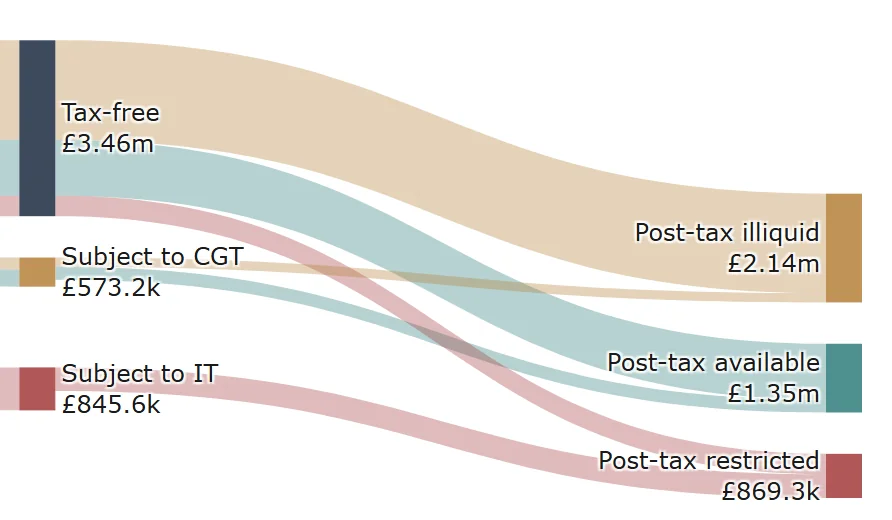
Fairworth covers the second and third pillars as you hold them: a workplace pension, a SIPP, ISAs and Lifetime ISAs, each recorded as its own account at the platform where it sits. On the paid plan, the Holdings page sorts everything you own by when you can reach it: now; not yet, as with pensions, Junior ISAs and Lifetime ISAs; or not easily at all. It also sorts it by how it would be taxed on the way out, and shows what would be left after tax at the tax band you set. It does not model the income a pension pays: there is no entry for the State Pension, and a defined benefit pension can be recorded only as an account with a value you enter, not as the income it will pay.
Swipe the screenshot sideways to read it
What this means in the UK
- The State Pension has no invested fund. The UK's is paid as it goes, with a working balance rather than an invested reserve; the US keeps a trust fund in Treasury obligations; Canada's CPP invests a fund worth about a quarter of GDP.
- A UK total depends on what is added up. Using the ONS survey in place of three of the four sources adds about £345bn, and a figure of about 74% of GDP that leaves out contract pensions still appears in international tables.
- DB still holds nearly half the UK's built-up total (47.3%), a larger share than in the US (26.6%), though 91% of UK private-sector DB schemes are closed to new members.
- SIPPs, where the saver chooses the investments, held about £567bn in 2024. Old workplace pensions can be traced and, in some cases, moved: see finding old workplace pensions and moving an ISA or SIPP to another platform.
More on Pensions
- Taking money from your pension: four routes ExplainerThe four ways to take money from a UK pension and how each is taxed, what people chose by pot size, how fast they drew it, and the minimums other countries set.
- Pension Wise, targeted support or advice ExplainerPension Wise guidance, targeted support and regulated advice: what each can do before you take money from a pension, and the checks you can run yourself.
- What pension default funds hold vs your mix ExplainerWhat UK, US, Canadian and Australian pension default funds hold in shares, bonds, cash and at home, set beside your own portfolio's mix.
Further reading
- The Purple Book 2025 (Pension Protection Fund): for UK private-sector DB schemes.
- Retirement income market data 2025/26 (FCA): for contract-based pensions, SIPPs and drawdown.
- The US Retirement Market, second quarter 2026 (Investment Company Institute): for US retirement assets by account type.
- Pension plans in Canada, as of January 1, 2025 (Statistics Canada): for Canadian employer pension plans.
- Quarterly superannuation performance statistics, June 2026 (APRA): for Australian super by fund type.
Figures are the latest each source published, checked on 12 November 2026, each with its own date. Pound amounts are converted at the Bank of England rate on each figure's own date and rounded. Rules are stated as at 12 November 2026. This page compares systems; it does not rank them. It is information, not financial or investment advice.