Private equity funds, tracked beside everything else you own
Fairworth records each private equity fund you have committed to, whether you hold it directly or through a feeder on a platform such as Moonfare: the commitment, every capital call and distribution, and each valuation from the manager's statements. It shows what is called and uncalled, DPI, TVPI and IRR, and counts the fund in your net worth next to your ISA, SIPP, property and mortgage.
1 · Each fund
What a fund's page shows
Every fund has a page of its own. Across the top it shows Commitment, Called, Called %, Uncalled, Distributed, NAV, DPI, TVPI and IRR, and Paid in as well when what you paid differs from what was called.
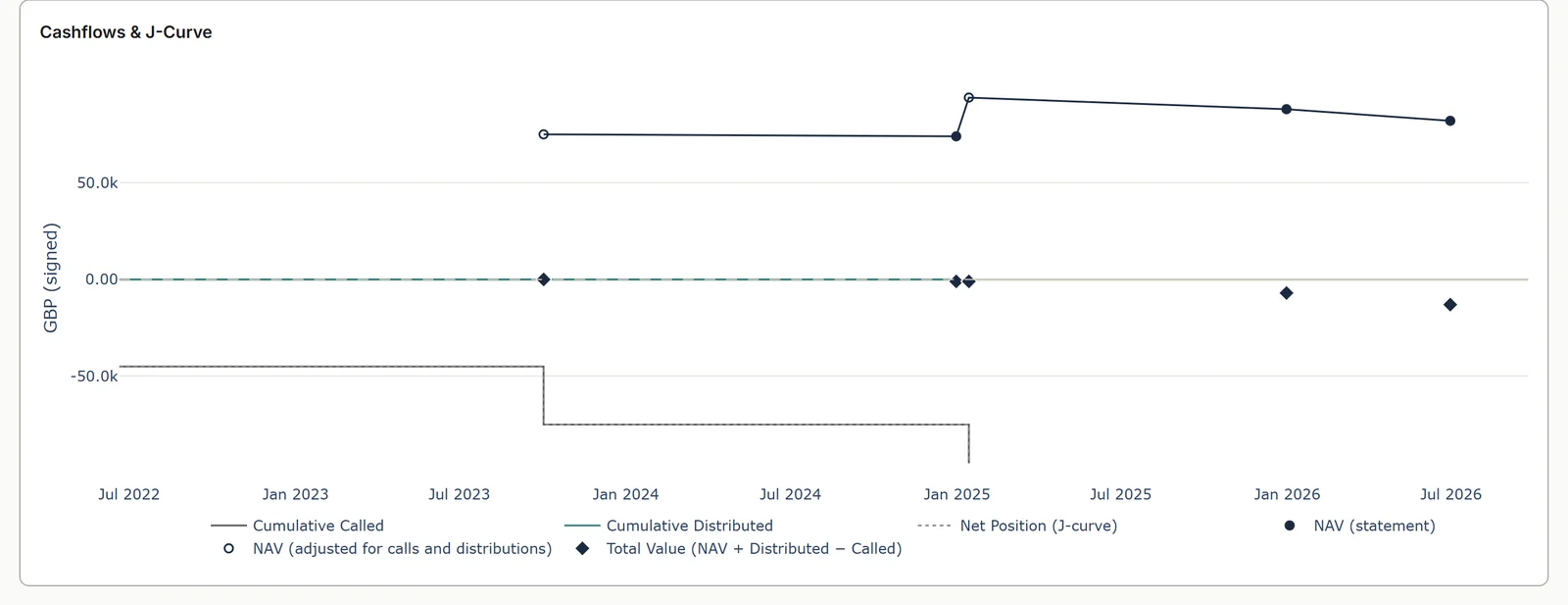
Statements arrive weeks after the date they report on, and calls and distributions happen in between. Between statements, the NAV is the last reported one plus calls, less distributions since. The NAV, DPI, TVPI and IRR tooltips give the last statement's date and the figure at that date. A fund with no statement yet is shown at cost.

Swipe the screenshot sideways to read it
The fund's whole life on one chart
The Cashflows & J-Curve chart draws the money called below zero, the money distributed, the net of the two, each NAV and the total value at each NAV's date. For a young fund that total can sit below zero: the dip of the J-curve.
The fund's terms, kept with it
Commitment, first close (which sets the vintage year), term, strategy, region, management fee, carried interest, hurdle, the manager and, for a feeder, the feeder's own yearly costs.
Every transaction, listed
Calls, distributions, valuations and secondary trades are listed on the fund's page and added from its menu: Capital Call, Distribution, Update NAV, Secondary Purchase and Secondary Sale.
Swipe the screenshot sideways to read it
2 · Less typing
Capital calls and statements, read from the PDF
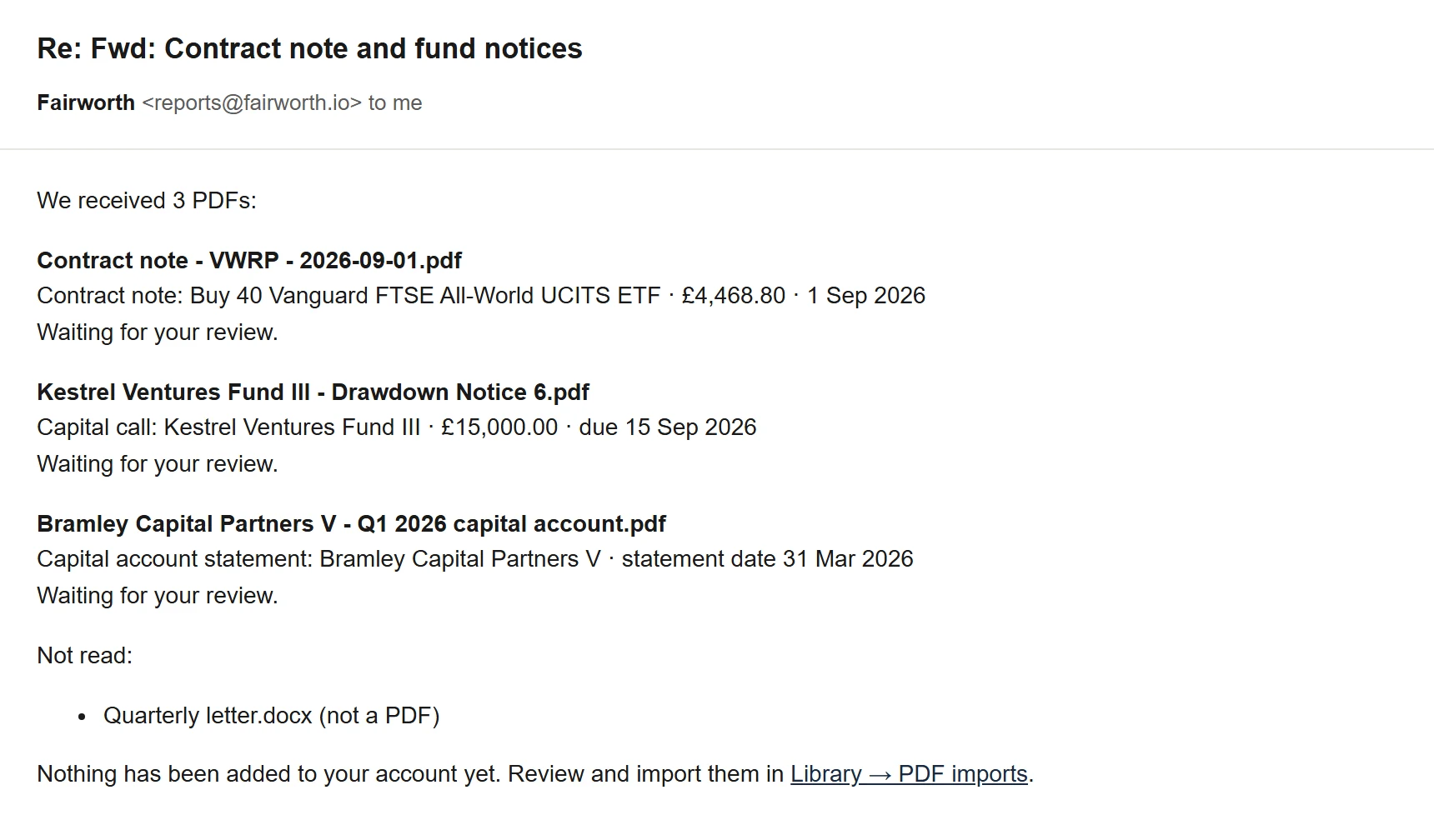
Upload a capital call notice, a distribution notice or a capital account statement to the document reader, or forward it to your own import address. Fairworth reads it, proposes the entries for the right fund, and saves nothing until you approve them.
The reader works from what each document says rather than a template for each platform. It has been checked on Moonfare's capital call notices and quarterly capital account statements. More on emailing documents in and the document reader.
Swipe the screenshot sideways to read it
Calls dated when they were made
A drawdown notice shows an issue date and a due date. The call is dated on the notice's issue date. If a call of the same amount is already recorded within a few weeks of it, you are told before you add it twice.
Statements fill only the gaps
A capital account statement is compared with what you have recorded. Figures that already match are shown and left alone; only a missing valuation, call or distribution is proposed. For a fund you have not added yet, it sets the fund up with its position to date.
A feeder's name, matched once
A feeder's documents often name the feeder vehicle rather than the fund you recorded. If the reader cannot match it, you pick the fund once, and the name is remembered for that fund's next document.
3 · Through a platform
Feeder funds and their fees
A platform often invests through a feeder: a vehicle that pools its investors' money, commits it to the underlying fund and adds costs of its own. Fairworth keeps the two layers apart, so the fund's figures still read as the manager reports them.
Fees on top of a call
A call has an optional fees field. Fees count in what you paid in, which DPI and TVPI divide by, but not against your commitment, so Called and Uncalled match the statement. Paid in then appears next to Called.
The feeder's yearly costs
A fund's terms have a field for feeder company costs, as a percentage a year, beside the management fee, carried interest and hurdle. It is 0 for a fund you hold directly.
Small differences, explained
What you wire for a feeder's drawdown can be a little more than the amount called on your commitment. When a statement is checked, a small difference of that kind is shown to you, not proposed as a new capital call.
For a feeder, the fund's manager field takes the underlying fund's manager, not the platform's name.
4 · Bought or sold second-hand
Secondary purchases and sales
An interest bought from another investor is recorded as a secondary purchase, either as a new fund or as a top-up of one you hold. What you paid is your cost, and DPI, TVPI and IRR are worked out from it. What the seller had already paid in counts towards Called, so Uncalled shows what can still be asked of you.
Selling part or all of an interest is recorded as a secondary sale, with the proceeds and the share sold.
5 · Against the market
Against an index, and against other funds
On each fund's page you pick an index, and two figures compare the fund's cash flows with it. KS-PME is the fund's value divided by what the same calls would be worth in the index: above 1.0x, the fund did better. Direct alpha is the yearly return above the index.
For how other funds of the same vintage year and strategy have done, the free private equity fund returns tool on this site shows TVPI and DPI by vintage year, as published by the public pension plans that invest in the funds. It needs no account. Why the same fund can report different returns: same fund, different returns.
6 · The whole picture
Next to everything else you own
A platform's dashboard shows its own funds. Fairworth counts your funds in your net worth beside listed investments, pensions, property and cash, less what you owe on mortgages and loans.
Each fund in its own currency
A fund is recorded in the currency it reports in, such as US dollars or euros, and converted at the rate for each date into the currency you choose. Where a rate is missing, the app says so rather than using today's rate or 1:1.
Uncalled against what you can reach
On the paid plan, risk limits compare your total uncalled commitments with your cash, with cash and gilts, or with everything you could reach now, and flag it when the share passes a limit you set.
The platform as an account
Moonfare is in the list of platforms an account can be held at, so the funds bought there sit in an account of their own. More on a whole net worth.
7 · Plans
What is free, and what is paid
The free plan includes one private equity fund, with its calls, distributions, valuations and a benchmark, entered by hand. The paid plan, £12 a month or £120 a year, takes any number of funds and adds the document reader, emailing documents in and risk limits. Everything in each plan.
Questions
What people ask about private funds
Can I track uncalled capital?
Yes. Uncalled is the commitment less what has been called, and it is shown on each fund's page beside Called and Called %. Fees charged on top of a call do not reduce it, and for an interest bought second-hand the seller's earlier calls do.
Does it handle feeder fees?
Fees on top of a call are recorded with the call and count in Paid in, which DPI and TVPI use, without counting against the commitment. A feeder's yearly costs can be recorded as a percentage in the fund's terms.
Do I have to type in every capital call?
No, on the paid plan. Upload the notice or forward it to your import address, and the document reader proposes the call for you to approve. On the free plan, calls are typed in from the fund's page.
Does it connect to my Moonfare account?
No. Fairworth has no connection to Moonfare or any other private-fund platform. Funds come in from the documents you upload or forward, or from what you type in.
What if a statement disagrees with what I recorded?
Figures that match are shown and left alone, and a missing valuation, call or distribution is proposed. A difference the reader should not fix on its own is listed for you, with a link to the entry.
Can I track a fund in dollars or euros?
Yes. Each fund keeps its own currency, and your totals are shown in the currency you choose, converted at the rate for each date.
Fairworth is not affiliated with, or endorsed by, Moonfare. Moonfare is named only to say which documents Fairworth has been checked on. Fairworth describes what you hold; it does not recommend any fund or platform.