From the age of 50, anyone with a UK defined contribution pension can get free, impartial guidance on what to do with it from Pension Wise. People attended 131,478 Pension Wise appointments in the year to 31 March 2026. In the same year, at FCA-regulated pension providers, 30.8% of plans accessed for the first time were accessed by people who took regulated advice. Since 6 April 2026 there is a third kind of help, targeted support, which sits between the two. This page sets out what each kind of help is, what it can and cannot do, and the checks you can run yourself. It describes the help; it is not a recommendation.
The kinds of help, side by side
| Kind of help | Who gives it | Cost to you | How personal |
|---|---|---|---|
| Pension Wise guidance | MoneyHelper, backed by government | Free | Explains your options; recommends no product |
| Targeted support | A firm with FCA permission, such as your provider | The firm decides | A ready-made suggestion for people like you |
| Regulated advice | An FCA-authorised adviser | Charged | A recommendation for you |
Pension Wise: free guidance from 50
Pension Wise is run through MoneyHelper. It is for people aged 50 or over with a defined contribution pension, personal or workplace, and the size of the pot does not matter; it does not cover final salary or career average pensions. A phone appointment takes about an hour, and you can also have one face to face or work through a version online. The specialist explains your options but does not recommend products or companies or tell you how to invest. Under 50, you can usually book only if you have inherited a pension, are retiring early through ill health, or your scheme lets you take your pension before 55; MoneyHelper's wider pension guidance has no stated age limit.
Since 1 June 2022, when you decide to access your savings, your provider has to explain what Pension Wise is, that it is free, and offer to book an appointment for you. With a trust-based (occupational) scheme, your application cannot go ahead until you have had the guidance or opted out, and the opt-out has to be a separate communication, which the trustees record. The requirement does not apply if you confirm you had guidance or regulated advice in the 12 months before applying. With a contract-based pension, such as a personal pension, a SIPP or a group personal pension through work, the FCA's rules let you opt out in the same conversation.
The 131,478 appointments compare with 1,047,008 plans accessed for the first time at FCA-regulated providers in the year to 31 March 2026. Appointments cover trust-based schemes too, which those figures leave out, and people often hold more than one pot, so the two do not compare one for one.
Targeted support: new since April 2026
Targeted support lets a firm give "suggestions designed for groups of consumers with common characteristics". The firm sets out groups of customers in advance and a ready-made suggestion for each, which has to suit the people in that group; it is less personal than advice, and a firm needs a separate FCA permission to give it. Under the FCA's rules of December 2025, the firm decides whether to charge for it, you can complain to the Financial Ombudsman Service, and you keep access to the Financial Services Compensation Scheme.
On 1 July 2026 the trade press reported, citing an FCA freedom of information answer, that 7 of 13 firms that applied had the permission: Royal London, Vanguard, Quilter, Legal & General, Zopa Bank, Monzo and Aviva. Another report puts the number authorised at 13, and we found no count published by the FCA. Legal & General's first use, announced in May 2026, is for workplace pension members whose savings are all held in cash.
Regulated advice
An adviser looks at your circumstances and recommends what to do, and charges for it. In a survey for its December 2020 review, covering investment advice generally rather than only pensions, firms charged on average 2.4% of the amount invested for initial advice and 0.8% a year for an ongoing service, before the charges of the products themselves. The FCA's Financial Services Register shows whether a firm is authorised and has permission for the service; using the contact details on the register guards against firms that copy a real firm's name.
Drawdown without advice: investment pathways
If you move into drawdown without advice, or transfer money in to do so, most providers have had to offer investment pathways since February 2021: a ready-made fund for each of four plans for the next five years. A provider expecting fewer than 500 such customers a year can opt out. The four, in the FCA's words, are "I have no plans to touch my money", "I plan to use my money to set up a guaranteed income (annuity)", "I plan to start taking money as a long-term income" and "I plan to take out all of my money". Take-up was about 50% in the first quarter of 2023, according to industry figures quoted in the FCA's review; we found no later figure when we checked in November 2026.
Checks you can run yourself
Scams. The FCA's warning signs, on its pension scams page as updated on 19 January 2026, include "a guaranteed better return", high-pressure sales and unusual, unregulated investments. It suggests hanging up on unexpected calls about your pension, checking that a firm is authorised and never taking advice from a company that contacted you, and it points you to its Warning List of unauthorised firms.
Old pots. Every pension scheme in scope had to connect to the pensions dashboards by 31 October 2026. As at 14 November 2026 we found no announced date for the public to use them; in May 2026 the Money and Pensions Service was reported to expect its dashboard to launch in the 2027/28 financial year. Until then, see how to find old workplace pensions.
Coming in 2028: value-for-money ratings
Under the Pension Schemes Act 2026, workplace defined contribution schemes are to be rated on investment performance, costs and charges, and service, as red, amber, light green or dark green. The first ratings are due by 31 October 2028, for the largest schemes only, and no consequences apply that year. From 2029 a scheme rated red would have to tell employers, produce an action plan and close to new business. The detail is in draft rules: the consultation closed on 15 September 2026 and final regulations are planned by January 2027.
What other countries do
In the US, the SEC's Investor.gov, the Department of Labor's publications and FINRA, the brokers' self-regulatory body, offer education for savers. Since 30 June 2020 a broker recommending, for example, a move from a workplace plan into an IRA has had to act in the customer's best interest under the SEC's Regulation Best Interest. The Department of Labor has twice tried to extend its stricter fiduciary standard to more retirement advice: its 2016 rule was struck down in 2018, and its 2024 rule was blocked by the courts in 2024 and vacated in March 2026, after the Department dropped its appeal. In Canada, the government's Retirement Income Calculator estimates income from state and private pensions and says its results are "estimates only".
Australia tests its MySuper default products every year, and since 2023 many choice products too, and publishes the ones that fail. In 2021, 13 of 76 MySuper products failed; in 2026, 1 of 50 did, along with 11 of 141 choice products sold through platforms. A trustee whose product fails must write to its members within 28 days, and a product that fails two years running cannot take new members until it passes. As at November 2026, the ATO's YourSuper tool compares MySuper products on fees and returns.
How Fairworth fits in
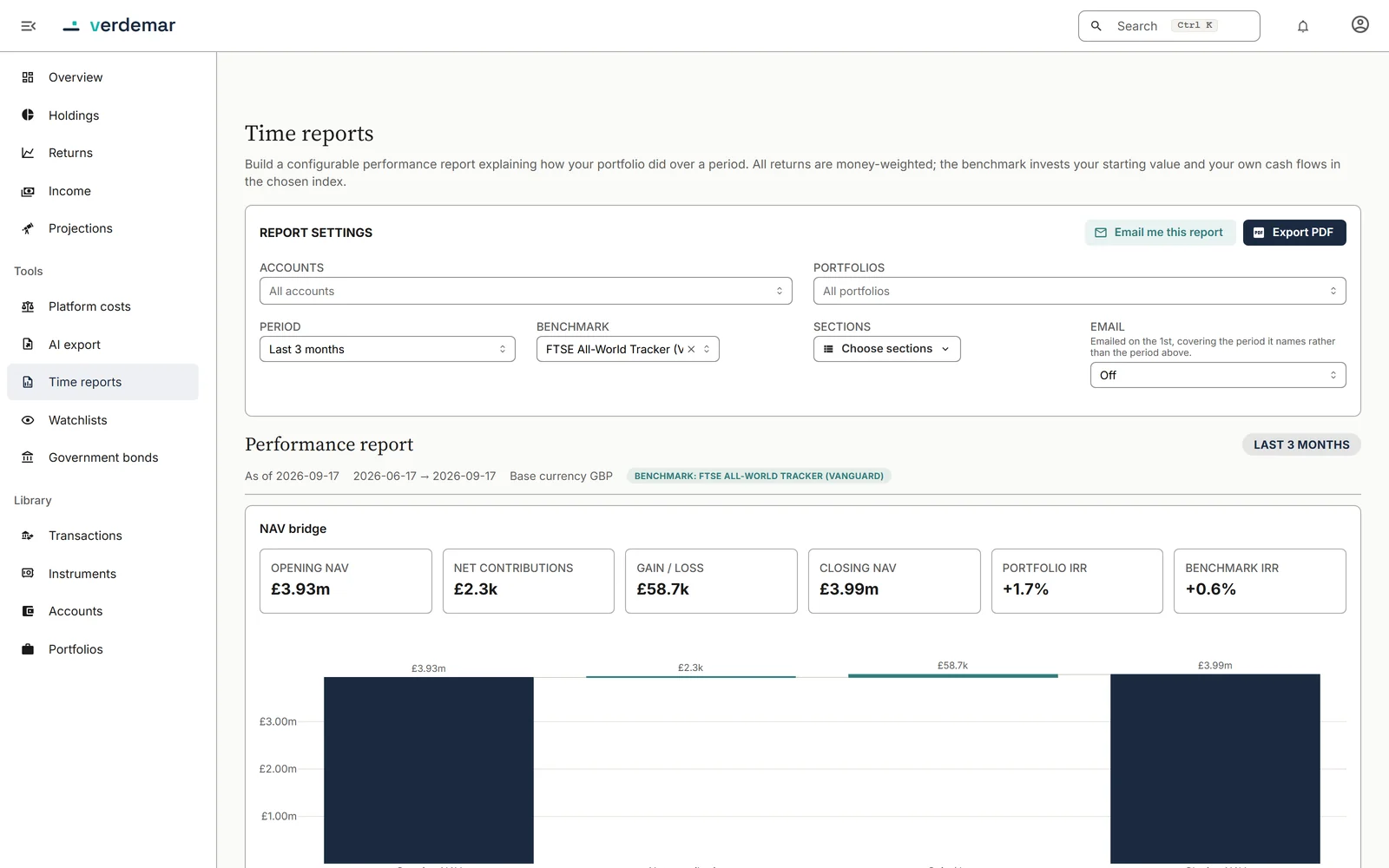
Each kind of help starts from what you hold. Fairworth keeps each pension as its own account beside your ISAs and other investments. On the paid plan, the Time reports page builds a report on everything you own, or on the accounts you choose, for a period you set: the value at the start and end, what you paid in and took out, your return beside a benchmark, where the money is invested and the income it paid. You can download it as a PDF, or have it emailed monthly, quarterly, every six months or yearly.
Swipe the screenshot sideways to read it
The free platform costs tool works out the yearly cost of a portfolio of a given size, mix of accounts and trading pattern at each UK platform it compares. On the paid plan, Fairworth works out what your platforms cost you each year from your real holdings, and prices the same holdings at each platform; a workplace pension is left out, because the employer chooses its provider.
What this means in the UK
- Guidance. Pension Wise is free from 50 for defined contribution pensions, and your provider offers it when you decide to take money out.
- Targeted support. It is new, the firm decides whether to charge, and the Financial Ombudsman Service and the FSCS apply.
- Advice. It is charged, and the FCA register shows whether an adviser is authorised.
- Ratings. Value-for-money ratings for the largest workplace schemes are due by 31 October 2028, under rules still in draft.
More on Pensions
- Taking money from your pension: four routes ExplainerThe four ways to take money from a UK pension and how each is taxed, what people chose by pot size, how fast they drew it, and the minimums other countries set.
- What pension default funds hold vs your mix ExplainerWhat UK, US, Canadian and Australian pension default funds hold in shares, bonds, cash and at home, set beside your own portfolio's mix.
- Workplace vs self-managed pensions: UK, US, Canada, Australia ExplainerWho chooses how pension money is invested in the UK, US, Canada and Australia: schemes, workplace defaults, or savers in SIPPs, IRAs, RRSPs and SMSFs.
Further reading
- Pension Wise (MoneyHelper): booking an appointment.
- Pension scams (FCA): warning signs and how to report one.
- How to find old workplace pensions: tracing pots you have lost track of.
- Workplace and self-managed pensions: who chooses the investments in each.
Rules and figures were checked on 14 November 2026, each with its own date. Targeted support and the value-for-money rules are new or in draft and may change. This page describes the help available; it does not rank it. It is information, not financial or investment advice.