In the year to 31 March 2026, 1,047,008 UK pension pots were accessed for the first time at FCA-regulated providers, which leaves out trust-based schemes such as master trusts. People could cash a pot in, move it into drawdown, buy an annuity or take it as a series of lump sums, and what they chose depended heavily on how big the pot was: most pots under £10,000 were cashed in, and most of £50,000 or more went into drawdown. This page sets out the four routes, how each is taxed, what people chose and how fast they drew the money out, and what other countries require. It describes the rules and what people did; it does not say which route suits anyone.
The four routes, side by side
| Route | What happens | How it is taxed | Paying in afterwards |
|---|---|---|---|
| Cash in full | The whole pot is paid out at once | Usually 25% tax-free, the rest taxed as income in that year | Capped at £10,000 a year, unless it is paid as a small pot of £10,000 or less |
| Drawdown | Up to 25% of each amount moved into drawdown can be taken tax-free as it moves; the rest stays invested and you take what you want, when you want | Withdrawals after the tax-free part are taxed as income | Capped from your first taxable withdrawal, not from taking the tax-free part |
| Annuity | Usually 25% tax-free first; the rest buys a regular income from an insurer | The income is taxed as income | Not capped if the income cannot go down, apart from in set cases; capped if it can |
| Partial lump sums | Cash taken in pieces straight from the pot (an uncrystallised funds pension lump sum, or UFPLS) | Each payment 25% tax-free, 75% taxed as income | Capped from the first payment |
The tax-free part is capped: across all your pensions it cannot exceed the lump sum allowance of £268,275 (2026/27), unless you hold an older protection, and any lump sum above it is taxed as income. A large withdrawal in one tax year can be taxed at a higher rate.
Taking money can also cap what goes in afterwards. Once you make a first taxable withdrawal from flexi-access drawdown, take a first partial lump sum or buy an annuity that can go down, the total that you and any employer can pay into defined contribution pensions each year without a tax charge falls to £10,000, the money purchase annual allowance (2026/27), against the standard annual allowance of £60,000, which is lower for some high earners. Taking only the tax-free cash, a small pot or an annuity that cannot go down does not trigger it, and nor does a defined benefit pension. You can cash in up to three small personal pension pots of £10,000 or less each, including group personal pensions from work, as small pots; small pots from occupational schemes have no such count limit.
The first taxable payment from a flexible withdrawal can be taxed too much. Without a P45 for the current tax year, the provider uses an emergency tax code on a month 1 basis. You can claim the excess back during the year with HMRC's form P55 if you took only part of the pot, P50Z if you took all of it and have no other work or pension income apart from the State Pension, or P53Z if you took all of it and still have a job or another pension; otherwise it is put right after the tax year ends. A small pot taken as a small lump sum has its own refund claim, listed separately on GOV.UK.
What people chose, by pot size
Of the pots accessed for the first time in the year to March 2026, 45.8% were cashed in full, 38.3% went into drawdown, 9.6% bought an annuity and 6.3% paid a first partial lump sum. The mix changes with the size of the pot. 81.8% of pots under £10,000 were cashed in, against 1.0% of pots of £250,000 or more, where 84.7% went into drawdown. Annuities were most common in the middle, at about one pot in five from £50,000 to £249,999. The FCA sizes drawdown and annuity pots after any tax-free lump sum and the other two before it, so a pot that went into drawdown can sit a band lower than it would if cashed in.
What people did with a UK pension pot the first time they took money from it, by pot size (year to March 2026): most pots under £10,000 were cashed in; most of £50,000 or more went into drawdown
Six small bar charts, one per pot size, each showing how the pots accessed for the first time in the year to 31 March 2026 at FCA-regulated providers were taken. Under £10,000: cashed in full 81.8%, drawdown 11.1%, annuity 2.2%, partial lump sums 4.9%. £10,000 to £29,999: 48.1%, 33.7%, 9.4%, 8.8%. £30,000 to £49,999: 25.0%, 50.8%, 17.3%, 6.8%. £50,000 to £99,999: 12.2%, 61.2%, 20.8%, 5.7%. £100,000 to £249,999: 3.4%, 71.8%, 18.8%, 6.0%. £250,000 and above: 1.0%, 84.7%, 7.3%, 7.0%.
Under £10,000
i
395,305 pots of this size were accessed for the first time at FCA-regulated providers (trust-based schemes such as master trusts are not covered). Pots are not people: one person can hold several. For drawdown and annuities the FCA sizes the pot after any tax-free lump sum; for the other two routes, before it. So the size bands are not exactly like for like. Shares worked out by Fairworth from the FCA's counts.
Source: FCA, Retirement income market data 2025/26, Tables 2, 3, 5 and 6 (year to 31 March 2026).
£10,000 to £29,999
i
230,583 pots of this size were accessed for the first time. For drawdown and annuities the FCA sizes the pot after any tax-free lump sum; for the other two routes, before it. So the size bands are not exactly like for like. Shares worked out by Fairworth from the FCA's counts.
Source: FCA, Retirement income market data 2025/26, Tables 2, 3, 5 and 6 (year to 31 March 2026).
£30,000 to £49,999
i
102,598 pots of this size were accessed for the first time. For drawdown and annuities the FCA sizes the pot after any tax-free lump sum; for the other two routes, before it. So the size bands are not exactly like for like. Shares worked out by Fairworth from the FCA's counts.
Source: FCA, Retirement income market data 2025/26, Tables 2, 3, 5 and 6 (year to 31 March 2026).
£50,000 to £99,999
i
121,626 pots of this size were accessed for the first time. For drawdown and annuities the FCA sizes the pot after any tax-free lump sum; for the other two routes, before it. So the size bands are not exactly like for like. Shares worked out by Fairworth from the FCA's counts.
Source: FCA, Retirement income market data 2025/26, Tables 2, 3, 5 and 6 (year to 31 March 2026).
£100,000 to £249,999
i
107,213 pots of this size were accessed for the first time. For drawdown and annuities the FCA sizes the pot after any tax-free lump sum; for the other two routes, before it. So the size bands are not exactly like for like. Shares worked out by Fairworth from the FCA's counts.
Source: FCA, Retirement income market data 2025/26, Tables 2, 3, 5 and 6 (year to 31 March 2026).
£250,000 and above
i
89,683 pots of this size were accessed for the first time. For drawdown and annuities the FCA sizes the pot after any tax-free lump sum; for the other two routes, before it. So the size bands are not exactly like for like. Shares worked out by Fairworth from the FCA's counts.
Source: FCA, Retirement income market data 2025/26, Tables 2, 3, 5 and 6 (year to 31 March 2026).
Show the figures as a table
| Country | Route | Share of pots | As of |
|---|---|---|---|
| Under £10,000 | Cashed in full | 81.8% | year to 31 Mar 2026 |
| Under £10,000 | Drawdown | 11.1% | year to 31 Mar 2026 |
| Under £10,000 | Annuity | 2.2% | year to 31 Mar 2026 |
| Under £10,000 | Partial lump sums: UFPLS | 4.9% | year to 31 Mar 2026 |
| £10,000 to £29,999 | Cashed in full | 48.1% | year to 31 Mar 2026 |
| £10,000 to £29,999 | Drawdown | 33.7% | year to 31 Mar 2026 |
| £10,000 to £29,999 | Annuity | 9.4% | year to 31 Mar 2026 |
| £10,000 to £29,999 | Partial lump sums: UFPLS | 8.8% | year to 31 Mar 2026 |
| £30,000 to £49,999 | Cashed in full | 25.0% | year to 31 Mar 2026 |
| £30,000 to £49,999 | Drawdown | 50.8% | year to 31 Mar 2026 |
| £30,000 to £49,999 | Annuity | 17.3% | year to 31 Mar 2026 |
| £30,000 to £49,999 | Partial lump sums: UFPLS | 6.8% | year to 31 Mar 2026 |
| £50,000 to £99,999 | Cashed in full | 12.2% | year to 31 Mar 2026 |
| £50,000 to £99,999 | Drawdown | 61.2% | year to 31 Mar 2026 |
| £50,000 to £99,999 | Annuity | 20.8% | year to 31 Mar 2026 |
| £50,000 to £99,999 | Partial lump sums: UFPLS | 5.7% | year to 31 Mar 2026 |
| £100,000 to £249,999 | Cashed in full | 3.4% | year to 31 Mar 2026 |
| £100,000 to £249,999 | Drawdown | 71.8% | year to 31 Mar 2026 |
| £100,000 to £249,999 | Annuity | 18.8% | year to 31 Mar 2026 |
| £100,000 to £249,999 | Partial lump sums: UFPLS | 6.0% | year to 31 Mar 2026 |
| £250,000 and above | Cashed in full | 1.0% | year to 31 Mar 2026 |
| £250,000 and above | Drawdown | 84.7% | year to 31 Mar 2026 |
| £250,000 and above | Annuity | 7.3% | year to 31 Mar 2026 |
| £250,000 and above | Partial lump sums: UFPLS | 7.0% | year to 31 Mar 2026 |
People paid £7.4bn into individual pension annuities in 2025, 4% more than in 2024 and the highest yearly total since pension freedoms were announced in 2014, according to the Association of British Insurers. The number sold fell 2% to 87,600, as the average purchase rose to £84,000.
How fast people draw
There is no set rate in the UK: in flexi-access drawdown there is no minimum or maximum amount you can take in a tax year. In 2025/26, 702,412 plans paid regular withdrawals, through drawdown or partial lump sums, at firms with at least 750 such plans; 45.7% of them paid out 8% or more of the pot in the year, and 27.7% paid out under 4%. Again the pot size matters. 83.6% of plans under £10,000 paid out 8% or more, against 15.5% of plans of £250,000 or more, where more than half paid out under 4%. The figures count what came out, not why: they do not show whether a plan was being run down on purpose or whether its holder had other income.
How much of the pot UK plans with regular withdrawals paid out in 2025/26, by pot size: 83.6% of plans under £10,000 paid out 8% or more, against 15.5% of plans of £250,000 or more
Two small bar charts by pot size for UK plans with regular withdrawals (drawdown or partial lump sums) in 2025/26. Share paying out 8% or more of the pot in the year: under £10,000 83.6%, £10,000 to £29,999 79.1%, £30,000 to £49,999 66.7%, £50,000 to £99,999 54.0%, £100,000 to £249,999 36.0%, £250,000 and above 15.5%; all plans 45.7%. Share paying out under 4%: 9.9%, 7.6%, 12.1%, 18.4%, 30.1% and 52.1%; all plans 27.7%.
8% or more of the pot in the year
i
Across all 702,412 plans with regular withdrawals, 45.7% paid out 8% or more. Covers drawdown and partial lump sum plans with a regular payment set up, at least one withdrawal in the year and money still invested at the end, at firms with at least 750 such plans. Ad hoc payments by the same people count too. Shares worked out by Fairworth from the FCA's counts.
Source: FCA, Retirement income market data 2025/26, Table 8 (2025/26).
Under 4% of the pot in the year
i
Across all plans with regular withdrawals, 27.7% paid out under 4%. The FCA's under 2% and 2% to 3.99% groups added together. Shares worked out by Fairworth from the FCA's counts.
Source: FCA, Retirement income market data 2025/26, Table 8 (2025/26).
Show the figures as a table
| Country | Pot size | Share of plans | As of |
|---|---|---|---|
| 8% or more of the pot in the year | Under £10,000 | 83.6% | 2025/26 |
| 8% or more of the pot in the year | £10,000 to £29,999 | 79.1% | 2025/26 |
| 8% or more of the pot in the year | £30,000 to £49,999 | 66.7% | 2025/26 |
| 8% or more of the pot in the year | £50,000 to £99,999 | 54.0% | 2025/26 |
| 8% or more of the pot in the year | £100,000 to £249,999 | 36.0% | 2025/26 |
| 8% or more of the pot in the year | £250,000 and above | 15.5% | 2025/26 |
| Under 4% of the pot in the year | Under £10,000 | 9.9% | 2025/26 |
| Under 4% of the pot in the year | £10,000 to £29,999 | 7.6% | 2025/26 |
| Under 4% of the pot in the year | £30,000 to £49,999 | 12.1% | 2025/26 |
| Under 4% of the pot in the year | £50,000 to £99,999 | 18.4% | 2025/26 |
| Under 4% of the pot in the year | £100,000 to £249,999 | 30.1% | 2025/26 |
| Under 4% of the pot in the year | £250,000 and above | 52.1% | 2025/26 |
Dates coming up
- 6 April 2027: pensions and inheritance tax. For deaths on or after that date, most unused pension funds and death benefits count towards the estate for inheritance tax. Death in service benefits are left out, and the exemptions for a spouse or civil partner and for charities still apply. The personal representatives are responsible for reporting and paying any tax due, and can have the pension scheme pay it out of the pension.
- 6 April 2028: minimum pension age 57. The earliest age you can usually take a pension rises from 55 to 57. Members of some uniformed services schemes, and people whose scheme rules gave them an unconditional right to an earlier age before 4 November 2021, keep the lower age.
- 2026 to 2028: State Pension age 67. It rises by a month at a time for people born from 6 April 1960, and everyone born from 6 March 1961 to 5 April 1977 reaches it at 67, the first of them in March 2028. A rise to 68 for later birth dates is legislated for 2044 to 2046.
What other countries do
The US, Canada and Australia all set a yearly minimum that rises with age: in the US from a set age, whether or not you have started drawing; in Canada once savings are in a RRIF; and in Australia once you start an account-based pension. The UK sets none. In the US, required minimum distributions from traditional IRAs and most workplace plans start at 73, or 75 for people who reach 74 after 2032. In Canada, an RRSP must be turned into a RRIF or an annuity, or paid out, by the end of the year you turn 71. In Australia, an account-based pension started with super has a minimum from 4% a year under 65.
The least that must come out each year, as a share of the account, at ages 75, 85 and 95: the US, Canada and Australia each set a minimum; the UK sets none
Three small bar charts of the minimum yearly withdrawal as a share of the account. US traditional IRAs and workplace plans (required minimum distributions, Uniform Lifetime Table): 4.1% at 75, 6.3% at 85, 11.2% at 95. Canada RRIFs: 5.8% at 75, 8.5% at 85, 20.0% at 95. Australia account-based pensions: 6.0% at 75, 9.0% at 85, 14.0% at 95. The UK has no minimum.
US
i
Required minimum distributions from traditional IRAs and most workplace plans start at 73 (75 for people who reach 74 after 2032). Each year's minimum is the balance at the previous 31 December divided by a factor from the IRS table: 24.6 at 75, 16.0 at 85, 8.9 at 95. A different table applies when the only beneficiary is a spouse more than 10 years younger. Roth IRAs have no minimum while the owner is alive.
Source: IRS, Publication 590-B (2025), Appendix B, Table III; IRS retirement plan RMD pages.
Canada
i
An RRSP must become a RRIF or buy an annuity, or be paid out, by the end of the year you turn 71. A RRIF's minimum is a prescribed share of its value on 1 January; before 71 it is 1 divided by (90 minus your age), so 4.0% at 65. At 95 and over it is 20%. The factor can be based on a younger spouse's or common-law partner's age.
Source: Canada Revenue Agency, Chart - Prescribed factors; CRA, options at 71.
Australia
i
Applies to account-based pensions started with super; super can stay in the accumulation phase with no minimum. The minimum steps up with age: 4% under 65, 5% at 65 to 74, 6% at 75 to 79, 7% at 80 to 84, 9% at 85 to 89, 11% at 90 to 94 and 14% from 95. The rates were halved from 2008-09 to 2010-11 and from 2019-20 to 2022-23; the full rates apply now.
Source: Superannuation Industry (Supervision) Regulations 1994, Schedule 7.
Show the figures as a table
| Country | Age | Minimum a year | As of |
|---|---|---|---|
| US | At 75 | 4.1% | 2025 tables |
| US | At 85 | 6.3% | 2025 tables |
| US | At 95 | 11.2% | 2025 tables |
| Canada | At 75 | 5.8% | in force 2026 |
| Canada | At 85 | 8.5% | in force 2026 |
| Canada | At 95 | 20.0% | in force 2026 |
| Australia | At 75 | 6.0% | in force 2026 |
| Australia | At 85 | 9.0% | in force 2026 |
| Australia | At 95 | 14.0% | in force 2026 |
In Canada and Australia, many people take only the minimum. In Canada in 2019, 51% of people drawing from a RRIF took only the minimum. Australia's Retirement Income Review (2020), citing 2019 industry analysis, said more than half of retirees over 65 drew down at the minimum rate. Annuities are rare in both: about 6% of Australian pension-phase accounts held one in 2020, and a 2023 Department of Finance report says annuities make up "a very small share" of retirement income in Canada.
How Fairworth shows it
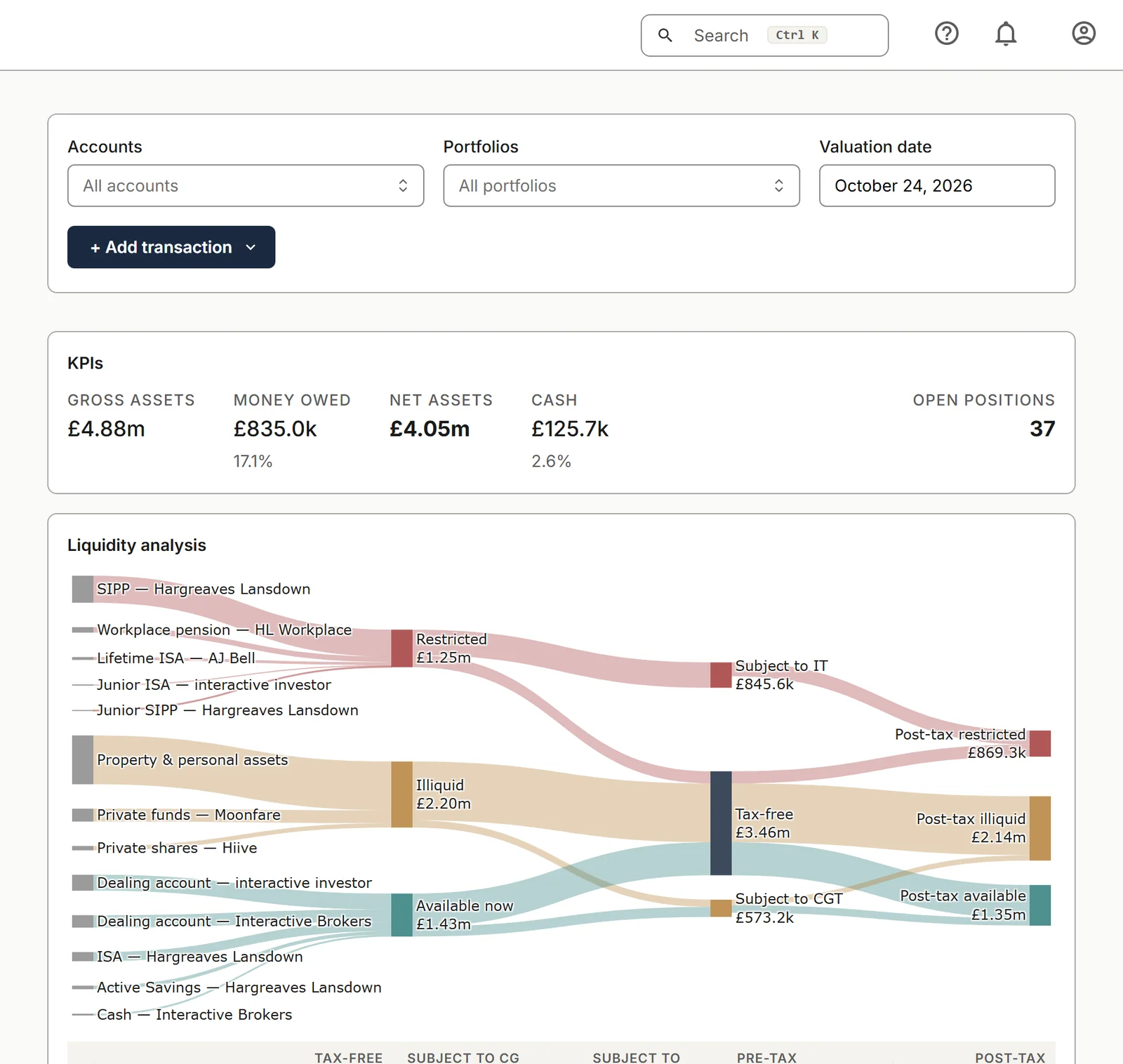
On the paid plan, the Projections page runs your portfolio forward year by year. You set the living expenses or withdrawals it has to pay, and the last year you earn a salary. It shows when your funds would run out in a low case, with a central case beside it. A pension is held back until you reach the minimum pension age, and the rest of the portfolio carries your costs until then; a pension that opens at 55 before April 2028 is held back again until 57. Protected pension ages are not modelled. With tax charges switched on, the first withdrawals from a pension are treated as tax-free until a quarter of it, up to the lump sum allowance, has come out, and the rest is taxed as income, a simplification of the rules above. The FCA's rates above are each plan's withdrawals as a share of that plan's own pot, so the matching figure for you is what you plan to take from a pension in a year divided by that pension's value, not by your whole portfolio.
The projection has no separate entry for the State Pension, or for the income from a defined benefit pension or an annuity: it takes one yearly income figure. For what you hold today, the paid plan's Holdings page applies the same pooled rule: your pensions are counted as restricted until pension age, a quarter of their combined value, up to the lump sum allowance, as tax-free, and the rest as income taxed at the band you set.
Swipe the screenshot sideways to read it
What this means in the UK
- Four routes. Cash, drawdown, an annuity or partial lump sums. Each has its own tax treatment, and a first taxable withdrawal, other than a small pot or an annuity that cannot go down, caps defined contribution payments afterwards at £10,000 a year (2026/27).
- Pot size. Most small pots were cashed in; most large ones went into drawdown.
- Rate. No minimum and no maximum in flexi-access drawdown; 45.7% of plans with regular withdrawals paid out 8% or more in 2025/26, far more often among small pots (83.6% under £10,000) than large ones (15.5% at £250,000 or more).
- Dates. Inheritance tax from 6 April 2027 and a minimum pension age of 57 from 6 April 2028.
- Help. Pension Wise guidance is free from 50 for defined contribution pensions; see the help you can get before you touch your pension.
More on Pensions
- Pension Wise, targeted support or advice ExplainerPension Wise guidance, targeted support and regulated advice: what each can do before you take money from a pension, and the checks you can run yourself.
- What pension default funds hold vs your mix ExplainerWhat UK, US, Canadian and Australian pension default funds hold in shares, bonds, cash and at home, set beside your own portfolio's mix.
- Workplace vs self-managed pensions: UK, US, Canada, Australia ExplainerWho chooses how pension money is invested in the UK, US, Canada and Australia: schemes, workplace defaults, or savers in SIPPs, IRAs, RRSPs and SMSFs.
Further reading
- Pension Wise (MoneyHelper): free guidance on the options.
- Retirement income market data 2025/26 (FCA): the figures behind the charts.
- Pension Wise, targeted support or advice: the help you can get first.
- How to find old workplace pensions: tracing pots you have lost track of.
Rules and figures were checked on 15 November 2026, each with its own date. The inheritance tax change and the rise in the minimum pension age are legislated but not yet in force. This page describes the routes and what people chose; it does not rank them. It is information, not financial, tax or investment advice.