Yes, if your shares or funds move as they are. Moving holdings from one platform to another without selling them, a transfer in specie, changes who holds them for you, not who owns them, so nothing is sold for capital gains tax (the HMRC guidance behind this is below). The cost you paid and the dates you bought on stay the same, and the gain is still measured from them when you eventually sell. What can change is the record: the new platform may not show the cost you paid unless the old platform passes it on. Its book cost is the platform's record, not the figure HMRC uses. This page covers shares and funds held in a general (taxable) account.
Why a transfer is not a sale
Platforms usually hold your investments through a nominee company: the nominee is the legal owner and you are the beneficial owner. For capital gains tax, HMRC treats what a nominee holds as held by the person it holds it for, and its Capital Gains Manual says a transfer of legal ownership between a nominee and the beneficial owner is not a disposal. It follows that when holdings move from one platform's nominee to another's, the legal holder changes but you remain the owner throughout: nothing has been sold.
A transfer that sells your holdings and moves the cash is different. The sale is a disposal, measured against your cost as usual. What you buy at the new platform is a new purchase, matched under the same rules as any other: bought back within 30 days of the sale, for instance, it is matched with that sale rather than added to your holding.
Your cost is one pool, whatever the platform
For capital gains tax, shares of the same class in the same company are held together in a single “Section 104 holding”, and each share in it is treated as costing the same average amount. HMRC's manual describes the pool as shares acquired “by a person in the same capacity”, and says nothing about platforms; with a nominee's holding counted as yours, shares in one company held in general accounts at two platforms are one holding with one average cost. Two rules come before the pool when you sell. Shares bought on the same day as the sale are matched first, then shares bought in the 30 days after it. Only the rest come from the pool.
So a platform's book cost is that platform's own record of what it holds for you. It may not be the cost HMRC uses, even if you never move anything. Once you hold the same share at two platforms, neither one's book cost need be the pooled figure.
An example
A made-up company, Northgate Widgets plc. You buy 100 shares for £8.00 each (£800) in a general account at one platform, and later 300 shares for £12.00 each (£3,600) in a general account at another. For tax you hold 400 shares costing £4,400, an average of £11.00 a share.
You transfer the first 100 shares to the second platform in specie on a day the price is £15.00. Nothing is sold. If the old platform does not send the cost, the new one might record those 100 shares at their value that day, £1,500. It would then show a book cost of £5,100 for 400 shares, £12.75 each.
Later you sell 150 shares for £16.00 each, £2,400, having bought none on that day or in the 30 days after. Leaving out dealing costs:
- The cost HMRC uses: 150 × £11.00 = £1,650, a gain of £750.
- The cost the new platform shows: 150 × £12.75 = £1,912.50, a gain of £487.50, which understates the gain by £262.50.
Had the new platform loaded the original £800, its book cost would have been £4,400 and the two figures would agree.
Why the new platform may show a blank or wrong book cost
Whether the cost arrives with the holding depends on both platforms. One platform's help page, for example, says it updates the book cost if the sending platform includes it, and otherwise asks you for your purchase details. Until the right cost is loaded, any gain or loss the new platform displays is not measured from what you paid. Its figure has no effect on your tax: the gain you report is worked out from what you actually paid.
What records show the original cost
GOV.UK lists the records to keep for capital gains tax: receipts, bills and invoices showing the date and amount of what you paid and of additional costs such as fees and Stamp Duty, what you received when you sold, contracts for buying and selling (from a stockbroker, for example), and copies of any valuations. For shares bought at different times, those records are what the pooled average is built from. GOV.UK says to keep them for at least a year after the Self Assessment deadline for the year you sell, and longer if your return was late or HMRC has started a check.
Funds that change unit class
A fund can have several classes of unit, for example with different charges. If a fund is exchanged for another class of the same fund, HMRC's Investment Funds Manual says this is not a disposal where the new units have substantially the same value and the fund's property and investors' rights are the same before and after (a change in charges is ignored). The new units are treated as bought when the original units were.
ISAs and pensions
Gains on shares held in an ISA are free of capital gains tax, so the book cost there changes the gain a platform shows you but not any tax. How to move an ISA or a pension without losing its tax wrapper, and what to check first, is in how to transfer an ISA or SIPP to another platform.
How Fairworth shows it
Fairworth keeps the cost of each holding itself, from the buys you record or import, whichever platform holds it. Switching platform does not depend on the old platform sending the cost or the new one loading it: the figure is already in your records, with the date you first bought it in that account.
Moving a holding is one step: a transfer from the old account to the new one, with no cost to type in. Before you save, the form shows how much of the cost moves with the units, how much stays behind and when the holding was first bought in the old account. Nothing is counted as sold, and the Holdings page goes on measuring each holding's unrealised gain from what you paid.
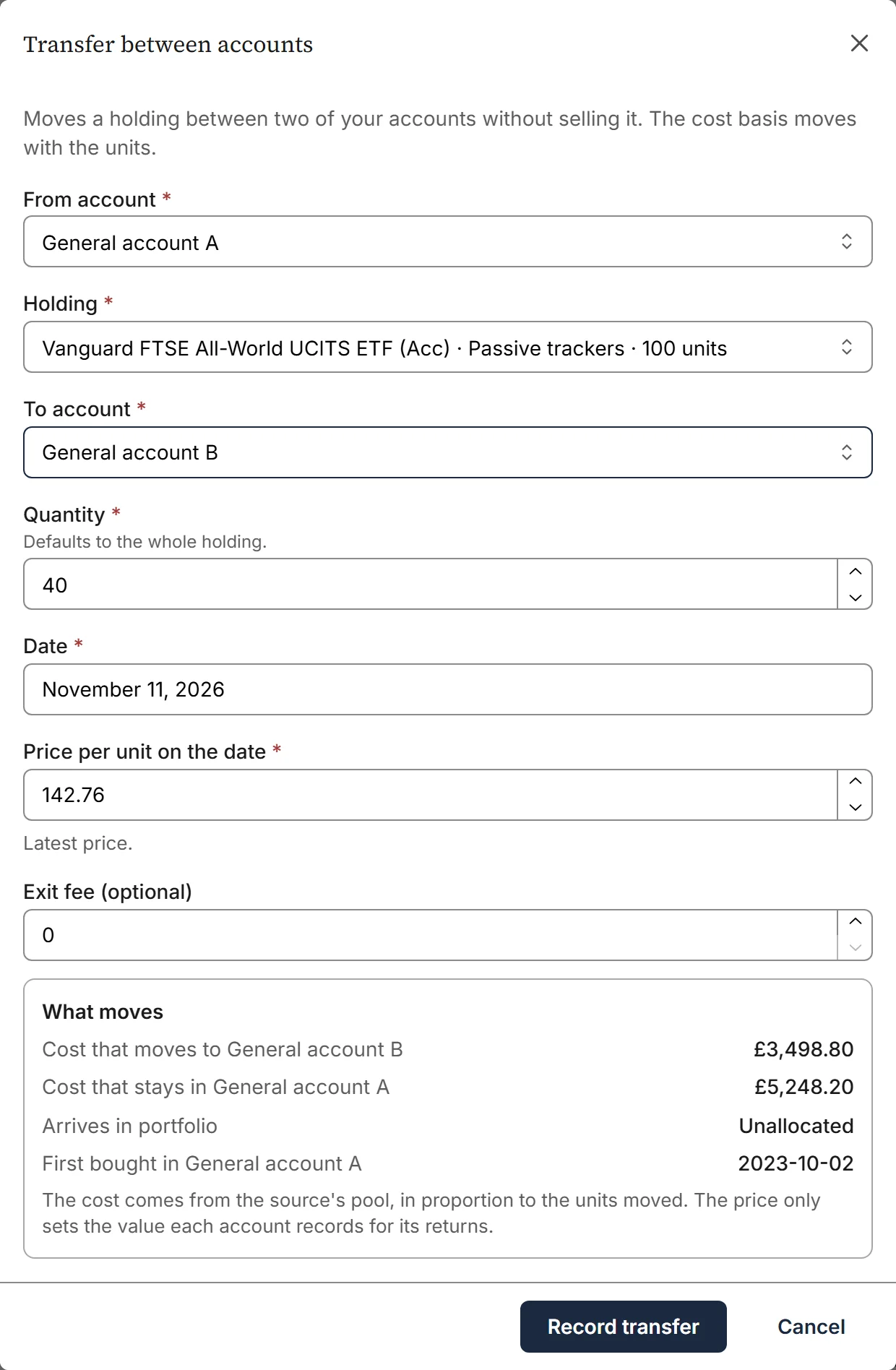
Between different types of account, such as a general account and an ISA, Fairworth records a sale and a purchase instead, and shows the gain the sale realises. Its cost is an average for each holding within each account. HMRC's pool covers all your general accounts together and applies the same-day and 30-day rules first, so in the example above, Fairworth shows £4,400 once all 400 shares are in one account, while across two accounts each keeps its own average. For the gain on a tax return, the pooled figure is the one that counts. What each holding would be worth after tax if sold is covered in what your investments are worth after tax.
More on Tax and wrappers
- EIS and SEIS loss relief when a company fails ExplainerThe loss after income tax relief, negligible value claims, and setting it against gains or income, with an EIS and a SEIS example.
- How to claim EIS and SEIS relief, and carry it back How-toThe EIS3 or SEIS3, the Self Assessment boxes, the claim form, carry back and the time limit, with a worked example.
- What your ISA, pension and investments are worth after tax ExplainerISAs, pensions, general accounts, property and gilts at 2026/27 rates, with a worked example.
Further reading
- Selling shares in the same company (GOV.UK)
- Shares and Capital Gains Tax, HS284 (HMRC)
- Chargeable persons: nominees, CG10702 (HMRC)
- Share identification rules from 6 April 2008, CG51550 (HMRC)
- Exchanges of units in the same fund, IFM16210 (HMRC)
- Capital Gains Tax: record keeping (GOV.UK)
The example uses an invented company and round figures. The rules are stated for the 2026/27 tax year and were checked against GOV.UK and HMRC's guidance in November 2026, after the 28 October 2026 Budget. Tax treatment depends on individual circumstances. This page is information, not tax or investment advice.