Shares in a private company have no market price, so any value you put on them is an estimate with a source and a date. A holder usually has four to choose from: what was paid, the price in the company's latest funding round, a figure the company or a platform reports, or a write-down. This page explains what each one means, and how to record it so that the value of your holding moves only when there is new evidence.
Why there is no single price
Listed shares change hands every business day, and the last trade sets the price. Unquoted shares rarely trade at all. When they do, it is usually a new funding round, a private sale or a takeover, each at a price agreed for that deal on that date.
For tax, unquoted shares are valued when a tax event needs it, such as a capital gain on a disposal or inheritance tax on an estate. For inheritance tax, GOV.UK says shares in a private company are valued at their open market value, looking at things such as the company's accounts, its assets, the size of the shareholding and the rights attached to it, and that HMRC's Shares and Assets Valuation team can be asked to consider the value. HMRC's Capital Gains Manual says that team does not value hypothetical cases. A holder's own estimate, for keeping track of what they own, is a different job: there is no tax return behind it, only the question of which figure to write down.
Four ways to value shares you hold in a private company
- Cost. What you paid per share. It is certain and dated, but it says nothing about what has happened to the company since.
- The latest funding round. The price per share new investors paid in the company's most recent raise. It is the latest price new investors paid, but only for that deal, on that date, and possibly for a different class of share with rights your shares do not have.
- A figure from the company or a platform. If you invested through a crowdfunding platform, its portfolio page may show a value for the holding. It may be the price in the company's last round multiplied by the shares you hold; a platform's help pages may say how its figure is worked out. A company's investor update may give a valuation of its own.
- A write-down. A lower value, or nothing, when there is evidence that the shares are worth less: a round at a lower price than before, a company entering administration, or a company that has been dissolved.
What a funding round price leaves out
A round price is set when new money comes in, and it then stays the same until the next round, which may be years away. A holding valued at it looks perfectly steady in between, whatever the business does. A later round can also come in lower than an earlier one. When it does, the lower price is the more recent evidence, even though it shows a loss.
None of these figures is a price you could sell at. There is often no buyer for unquoted shares at all, so the value on your balance sheet is a record of evidence, not of what the holding would fetch today.
An example
An invented company, Harrow Lane Robotics Ltd, raises money through a crowdfunding round. On 10 March 2023 you buy 2,000 shares at £1.50 each: £3,000.
On 2 September 2024 the company closes a larger round at £2.40 a share. Valued at that price, your holding is 2,000 × £2.40 = £4,800.
On 15 June 2026 it raises again, this time at £0.90 a share. Valued at the new price, the holding is 2,000 × £0.90 = £1,800.
Recorded this way, the holding's value changes on three dates only: £3,000 from March 2023, £4,800 from September 2024 and £1,800 from June 2026. Valued at cost, it would read £3,000 throughout, the figure from March 2023.
Recording a value, step by step
- Record the purchase at the price per share you paid, on the date you paid it.
- Record each new value as a revaluation when there is evidence for one: a new funding round, a valuation in an investor update, a change on the platform's portfolio page.
- Date it to the evidence, not to the day you noticed it. A round that closed in June is a June value.
- Note the source beside it, so you can tell later whether a figure came from a round, a platform or your own estimate.
- Record a write-down to zero if the company fails. Zero is a valuation, not a missing one.
How Fairworth shows it
Fairworth has an asset type for private shares. You record a buy, a sell or a revaluation, each with its own date. A buy and a revaluation each state a price, and a revaluation at zero counts as a valuation; a sale does not set a price. The holding's price is a step series: it stays at the latest stated price until the next one, and that price carries forward to today. The holding's page marks each valuation on its price chart, and shows the last price beside the date of the most recent revaluation.
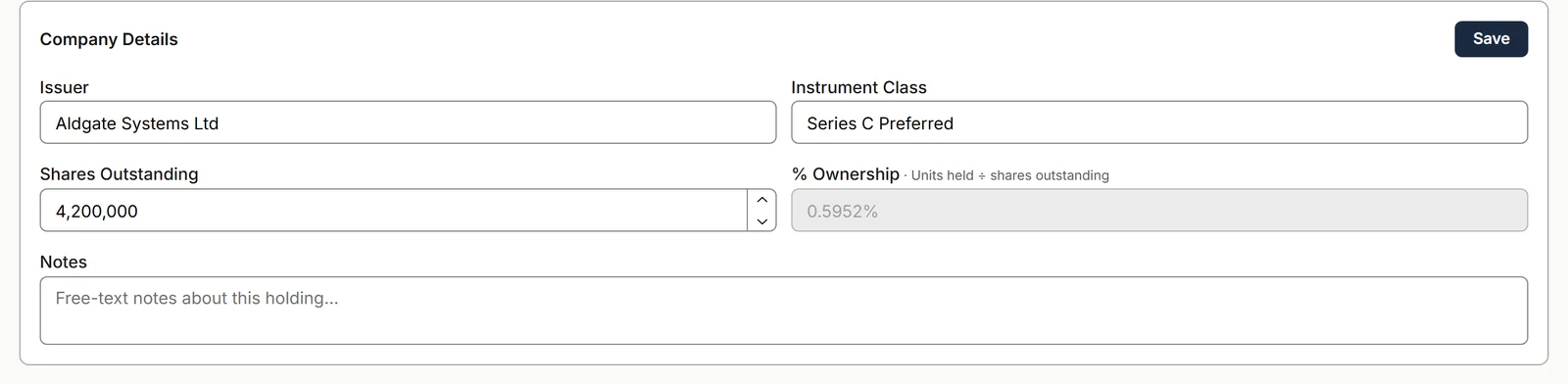
Each holding also has a Company details card for the issuer, the class of share, the number of shares the company has in issue and your notes. From the shares outstanding and the units you hold, it works out the percentage of the company you own.
In the Liquidity analysis on the Holdings page, private shares count as illiquid assets, with private funds and property: holdings that cannot usually be sold quickly at market value. Shares held in an account you cannot yet draw on, such as a pension, count under restricted access instead. Private equity funds have an asset type of their own, with their calls and distributions; see how to track a private equity fund.
More on Private markets
- How to track a private equity fund: calls, DPI and TVPI ExplainerCommitment, called and uncalled capital, how DPI and TVPI are worked out, and why a young fund looks poor.
Further reading
- Valuing stocks and shares for Inheritance Tax (GOV.UK)
- Unquoted shares: is a valuation required? CG59561 (HMRC)
- Net worth: should the house and pension count? (Fairworth)
The company and its figures in the example are invented, and are not a view on what any real company's shares are worth. HMRC's and GOV.UK's guidance was read in October 2026. This page is information, not tax or investment advice.