A gilt goes ex-dividend seven business days before each coupon is paid. A trade that settles on or before that date passes the coming coupon to the buyer. A trade that settles after it does not: the seller keeps the coupon and pays the buyer back the interest for the days left until it is paid. That refund shows on the contract note as negative accrued interest. This page covers conventional gilts.
When a gilt goes ex-dividend
A conventional gilt pays its coupon in two equal halves, six months apart, on fixed dates. A payment date that falls on a weekend or a bank holiday rolls forward to the next business day. Because gilts are registered, the registrar has to know who to pay before the money goes out, so each gilt has an ex-dividend date seven business days before each payment date. Whoever is the registered holder at close of business on that date receives the whole coupon. The registrar calls it the record date.
The UK Debt Management Office (DMO) gives an example: for a coupon paid on 31 January 2025, the ex-dividend date was 22 January 2025. Counting back seven business days skips the weekend in between.
Settlement date decides, not the day you deal
Entitlement to the coupon follows the settlement date, not the trade date. Gilt trades normally settle on the next business day, known as T+1. So in practice:
- A deal struck the business day before the ex-dividend date settles on the ex-dividend date itself. The buyer is the registered holder that evening and receives the coupon.
- A deal struck on the ex-dividend date or later settles after it. The seller receives the coupon, even though they no longer hold the gilt when it is paid.
That answers a common question: will a purchase made two business days before the ex-dividend date receive the coupon? On normal T+1 settlement, yes, because it settles before the date passes. A deal agreed for later settlement is judged by its own settlement date.
What happens in the ex-dividend period
Between the ex-dividend date and the payment date the gilt trades "ex-div". Ordinarily a buyer pays the seller the interest built up since the last coupon, because the buyer will receive the whole of the next one. In the ex-dividend period it works the other way round. The seller will receive the whole coupon, including interest for days when the buyer owns the gilt, so the seller pays the buyer that interest instead. The DMO calls it rebate interest.
- Accrued interest is negative. It covers the days from settlement to the coupon date.
- The dirty price is below the clean price. The dirty price is the clean price plus accrued interest, so a negative accrual brings it below the quoted price.
- The total on the contract note is lower than the nominal times the clean price. That is the convention, not a mistake.
An example
An invented gilt pays a 4% coupon on 15 March and 15 September, so each coupon is £2 per £100 nominal. The coupon period from 15 September 2026 to 15 March 2027 has 181 days. Counting back seven business days from Monday 15 March 2027 puts the ex-dividend date on Thursday 4 March 2027.
Dealt on Wednesday 3 March, settling Thursday 4 March (cum-dividend). £10,000 nominal at a clean price of 99.00 costs £9,900.00. Accrued interest for the 170 days since 15 September is 2 × 170 ÷ 181 = 1.8785 per £100, so £187.85. Total: £10,087.85. The buyer receives the £200 coupon on 15 March.
Dealt on Thursday 4 March, settling Friday 5 March (ex-dividend). The same nominal at the same clean price. Rebate interest for the 10 days from 5 March to 15 March is 2 × 10 ÷ 181 = 0.1105 per £100, so −£11.05. Total: £9,888.95. The seller receives the £200 coupon; the buyer does not.
The two totals differ by £198.90. That is the £200 coupon less one day of interest (£1.10), the day between the two settlement dates. Before tax, one buyer pays the seller for the interest built up so far and receives the whole coupon; the other pays less and goes without it.
Does the price drop when a gilt goes ex-dividend?
The quoted clean price leaves out accrued interest, so nothing in the convention moves it on the ex-dividend date; it moves with the market as it does on any other day. What changes is the accrued interest. In the example it goes from about £188 per £10,000 nominal to about −£11 overnight, so the dirty price, the amount that actually changes hands, falls by roughly the value of the coupon.
The last coupon before redemption
The DMO notes that trades cannot settle in a gilt's final ex-dividend period, the days before it redeems. Whoever holds the gilt when it goes ex-dividend for the last time receives both the final coupon and the £100 per £100 nominal repayment.
How an ex-dividend trade is taxed
Outside an ISA or a pension, a gilt's coupon is taxable interest for whoever receives it, so on an ex-dividend sale it is the seller who is taxed on the whole coupon. The Accrued Income Scheme then evens this out. HMRC's helpsheet HS343 describes the case: the seller can claim an accrued income loss for the interest refunded to the buyer and deduct it from the interest received, and the buyer is taxed on an equivalent amount: HMRC's manual (SAIM4020) describes it as the rebate interest. Holdings small enough in nominal value are exempt from the scheme; HS343 sets out the limit and how it is tested. The scheme in general, and the clean and dirty price, are explained in Gilt accrued interest and the dirty price. GOV.UK says interest in an ISA is not usually taxed, so for a gilt held there none of this normally applies.
How Fairworth shows it
A gilt you hold has a page of its own, and its Gilt details card shows the ex-dividend date for the next coupon. Fairworth works it out as seven business days before the next coupon date, skipping weekends and England and Wales bank holidays.
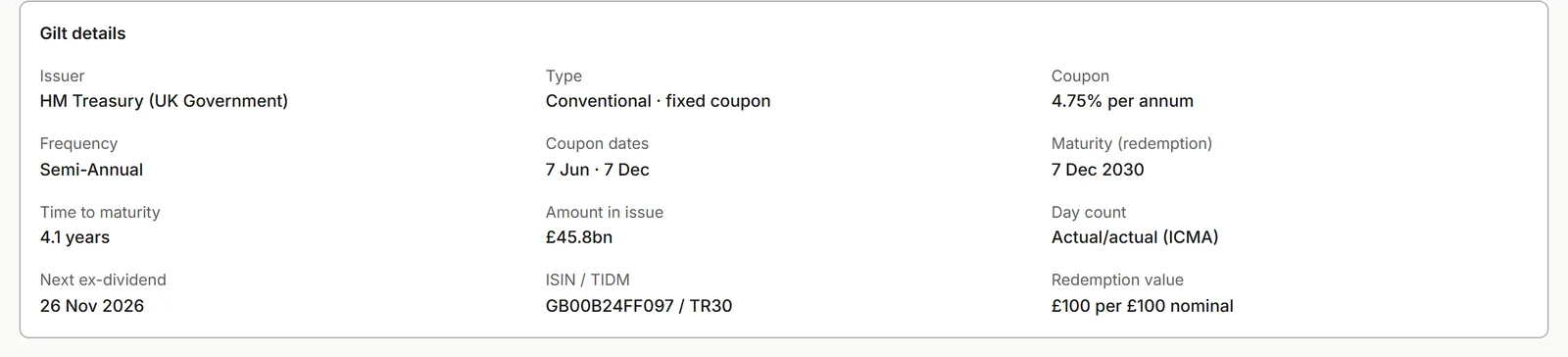
When you record a gilt purchase or sale, the amount stored is what changed hands: the clean consideration plus accrued interest to the T+1 settlement date. If the deal falls in the ex-dividend period, the accrued interest is negative and the form says the deal is ex-dividend, so a total below the clean consideration does not look like an error. The document reader says the same when it reads an ex-dividend gilt contract note.
Coupons on the gilts you hold are recorded on their payment dates, each with its ex-dividend date, and the same cut-off decides both whether a purchase was ex-dividend and whether that holding receives the coupon. A gilt you held before it went ex-dividend is valued at its clean price plus the interest accrued to today, right through the ex-dividend period, because the coming coupon is still owed to you. On the Government bonds page, the yields shown for a gilt that is in its ex-dividend period leave out the coupon a buyer would not receive. For how gilts that redeem one after another fit together, see What is a gilt ladder.
More on Gilts and cash
- What is a gilt ladder, and how is it taxed? ExplainerGilts redeeming one after another, why a low coupon changes the tax, and who it makes no difference to.
- Gilt accrued interest and the dirty price, explained ExplainerWhat the contract note is charging you for, why it is sometimes negative, and how the Accrued Income Scheme taxes it.
Further reading
- About gilts (UK Debt Management Office)
- Accrued Income Scheme, HS343 (HMRC)
- Accrued Income Scheme: transfers with or without interest, SAIM4020 (HMRC)
- Tax on savings interest (GOV.UK)
The example uses an invented gilt and round figures, and is not a quote for any real gilt. The market conventions were checked against the DMO's published description of gilts, and the tax treatment against HMRC's helpsheet HS343 (2026 edition), in October 2026. Tax treatment depends on individual circumstances. This page is information, not tax or investment advice.